How much do web designers in South Africa charge? A question we’ve been asked countless times, and one we feel web designers will continue getting asked for many more years to come. Truthfully, there is no clear-cut, right or wrong answer to this question.
Web design prices in South Africa considers all ‘checklist’ questions designers set out to ask or base their price on. And for every web designer, this looks different.
In a previous article we discussed the price of a website in South Africa based on 3 core factors: what you do, the number of pages you require and the hosting and post-design maintenance your website will need. There is no clear-cut, right or wrong answer to the question: how much web designers charge in South Africa.
In this article, we would like to explore 3 key points that play a role in the cost of a website in South Africa.
1. Who is designing the website?
With web design in South Africa seeing a significant growth through the years, so has the demand for websites and the number of web design professionals at the disposal of businesses.
These professionals come in the form of fully-fledged web design agencies and freelancers alike. Both of which have good and bad benefits, which can make it hard to decide who to go with.
Freelancers are often deemed “cheaper” and more flexible with their prices as they don’t have as many overhead costs (salaries, rent, running costs etc) as an agency typically would. To some degree – there is truth in this, but not all web design companies charge an “arm and a leg”, and sometimes, an agency can be cheaper than a freelancer.
I guess it essentially comes down to who a business sees as the right fit and feels most comfortable with.
2. Level of experience and area of expertise?
The price of a website can be attached to the level of experience and area of expertise of your potential web designer. A web designer who is just starting out, may offer web design services at little to no cost, simply to help build their portfolio. Likewise, a seasoned web designer who knows what they’re doing may charge more.
Although a web designer needs to be versatile, they may find themselves drawn to different aspects of web design. Some may find they enjoy working on e-commerce websites more than a straightforward business website. Some focus more on smaller websites with less content. Some may focus on one industry (eg: real estate websites).
3. Do they offer monthly packages or a once-off fee?
Not everyone is in favour of monthly web design packages, but not all businesses can afford a bucket load of money for a once-off website. With both options being offered at different price points, businesses can decide which would be the right choice, depending on their business.
With once-off prices, businesses usually pay for what they need and nothing more. Additional factors like the monthly hosting a website requires, and the maintenance thereof is usually not factored into this cost.
If you’re tech savvy and capable of maintaining your website yourself, then paying for a once-off fee for your website is a viable option.
Monthly web design packages are not merely about catering for the business who needs a more affordable option, the price you pay monthly will generally include your hosting and maintenance. It also means you have access to professionals who know what they are doing and what your website needs.
For more details about our web design packages,
click here.
When it comes to
web design prices in South Africa, businesses can pay as much or as little as they want to. It is important to consider the different of the website, and the design brief the web design company will have to carry out before deciding who your ideal web partner will be.
If you think having a website is optional, then you’re living in the wrong century. Businesses have come to rely so much on a website and it being accessible to their clients, a moment of ‘downtime’ can seem like a lifetime to them.
This means choosing a reliable and trustworthy web hosting provider is crucial for any business. But with so many big and small hosting companies to choose from, it may be difficult to tell the good from the bad, especially if you’re not sure what to look for.
Lets look at 5 helpful tips on
how to choose a web hosting company.
1. Support
It’s important to know that if you experience any issues with your website or your email accounts, you have a web host who can offer the required support in a time of need.
Be sure to ask your potential hosting company when and how they are available when needed. Some have technical consultants available 24/7 for phone or chat support.
2. Backups
In the event of your website getting hacked or files getting lost or deleted, a backup of your website files and emails is crucial. You’ll save yourself a ton of time (and potentially money), and avoid the risk of having to start from scratch.
Check whether they provide a backup service, and how frequently backups are made.
3. Uptime
We mentioned downtime earlier, and there’s no doubt that it can be frustrating - for you and your website visitors. A website that is up, fast and supported will perform better and allows for a better user experience.
4. Accessibility
A good and reliable website hosting company will allow you access to the server, so you can make any necessary changes to your website. You should also be able to access your emails via an internet browser. If the host makes it difficult for you to do either of these, then we suggest you seek an alternative hosting provider.
5. Contracts
Before you sign any contract with a hosting provider, be sure to look at the fine print. While some offer long-term contracts, others work on a
month-to-month, cancel at any time agreement.
With Web Partner, you get fast and reliable hosting package options based on your needs. We provide a safe and stable service within a secure environment and ensure that your website is up and running and supported.
The business world is like a jungle filled with highly competitive entrepreneurs facing endless challenges. And while some may rise to the top, others face a less favoured reality. Their downfall? Undermining the value of customer service.
Lets take a minute to put this into perspective:
Imagine John socialising with his friends, casually chatting about life and work.
Paul congratulates John on the recent launch of his business website, and John, pleased with the service and website he received from
Web Partner cannot recommend them enough.
Paul himself has been looking for someone to redo his website, and given the pleasant experience John had, he feels comfortable to entrust Web Partner with his web design requirements.
Moral of the story:
Give a customer a great product, and they will talk about it for 5 minutes. But deliver excellent service, and they will talk about it forever.
Here are 7 reasons
why you should make customer service a priority.
1. Increases your revenue
All business decision entrepreneurs make is dependent on revenue. And while a profitable business is not solely built on customer service, it is an important factor that must be considered for short and long-term financial growth and sustainability.
2. Free advertising
Advertising a business costs money. But you can turn your existing customers into brand advocates who will not only purchase more but will potentially bring in new business by word-of-mouth recommendations.
Studies indicate that 69% of customers who have a positive experience with a company are bound to recommend them to others.
That’s right, you can get people talking about your brand at no cost by simply delivering great service to your customers.
3. Customer retention is cheaper than customer acquisition
If you work on keeping your current customer base happy, you’re almost guaranteed to have them as repeat customers in the future. The more loyal customers you have, the more your business is likely to grow. To some extent, this could significantly bring down your customer acquisition cost.
4. Strengthens your company culture
When you set a precedent and create a culture of adding value and serving others, your employees will do the same. More so, it allows them to work better as a team and boosts the team morale.
5. Gives you a competitive edge
Competition – every business has it and now more than ever, more businesses are entering the market. Great, value added customer service will help you retain your existing customers and attain new ones. It also attaches value to your brand and sets you apart from your competitors.
Having worked with more than 10 000 small businesses over the last 7 years, offering web design services and marketing solutions to our clients, much of our success has been because of great service.
We know that if we nail customer service, it positively impacts all other aspects of our business and motivates us as a team. Likewise, if we fail at it, we feel its negative impact too.
Customer service ought to be at the core of every business, and if your aim is to make headway, you need to listen to your customer’s needs and respond to it with their best interest at heart.
When a business takes off it’s an exciting time for the business owner, understandably so. Your first instinct might be to share it with the world, so, what do you do? You hop onto social media (given that’s where people are most active), and you set up Facebook and Instagram pages for your business.
But after you’ve added all the information you’ve been instructed to add and completed all the ‘steps’, now what?
At this point, you might be tempted to publish your first post. But ask yourself - do you have a plan of action mapped out? If not, we reckon you hold off posting.
A social media strategy is in essence an action plan geared towards social media. It takes into account: your social media goals, the efforts that need to be put into place to achieve these goals, which platforms are best suited for the type of business you have and which content types you’d need to focus on.
And, a strategy is also the backbone that’ll allow you to measure both paid and organic success on social media.
But here’s the thing - people tend to underestimate the importance of a social media strategy, and quite often, they’ll neglect it altogether.
What’s your social media strategy?
No two businesses are the same, so your social media goals and the platform you use will depend on the type of business you have.
Let’s take a look at some common social media goals businesses tend to set for their pages.
1. Increase brand awareness
If there’s one thing social media platforms are great at, it’s spreading a message far and wide. So, if the goal is to increase your brand’s awareness, you want your brand to be discovered by as many people as possible.
How do you get there? Broaden your reach. Communicate what your brand is about, your brand values and what products you are selling or services you are offering. More importantly, make sure your content resonates with your audience. The more impactful people find your content, the more it will encourage them to share it.
The aim should of course be to have a great organic reach, since that is unpaid viewership. The alternative, which many businesses have found effective is to reach more people by means of boosted content or paid campaigns.
2. Drive traffic to your website
On its own, social media is good for business, couple it with a website and you have a winner! And if we have to be honest, social media can never replace a website.
Social media platforms will often redirect people to your website, as this is generally where most conversions take place. Be sure to add your website link to your bio and in your posts.
3. Increase sales
A boost in sales is one of the top goals for any business. Whether you are an e-commerce brand or run a service based business, with the right social media strategy, you can easily and effectively increase your sales.
4. Improve customer satisfaction
As a communication tool, social media can be utilised for so much more than educating people about your products or services. If you take time to invest in meaningful communication and conversations with your followers, you build trust and improve customer satisfaction, which ultimately leads to brand loyalty.
Need help identifying your social media goals and putting a social media strategy in place? Speak to our social media team, This email address is being protected from spambots. You need JavaScript enabled to view it.
Website hosting is a service rendered by a web hosting company that allows your website to be viewable on the internet. Think of it as a landlord vs tenant relationship; the web host will offer you space and bandwidth to store your website files on its servers.
Is web hosting really necessary though? The simple truth is: every website you’ve ever come across on the internet is being hosted. So, yes, hosting is an essential part of a business’ web presence.
Now that you have a basic understanding of what website hosting is and why you would need it, lets dive into some factors that will give you a bit more insight.
How does web hosting work?
Hosting companies rely on servers used to host the websites of their clients.
A server is a computer that provides resources, services and data to other computers over a network. In essence, this simply means your website files (content, images, videos etc) get uploaded from a local computer onto a web server.
The web hosting provider will offer clients a number of
website hosting packages based on the website needs. And depending on the hosting package you sign up for, you’ll either have a shared server, a virtual private server or a dedicated server.
Shared server is as its name suggests, a server shared with other customers. They are best suited for smaller websites that doesn’t have much content.
A virtual private server is a server type reserved for you, so you don’t have to share data, space or bandwidth with other users.
Dedicated servers are ideal for websites with a large stream of site visitors. This server type offers dedicated resources to a single client.
Choosing the right website hosting company
Choosing a hosting company that is the right fit for your business is an important step. And since it’s a long-term relationship you’ll be investing in, all factors need to be taken into account.
Sometimes, you may feel swayed by the price at which a host provider offers its services, but price alone cannot be the deciding factor on who you partner with.
Do some research on how to choose a web hosting company and look into factors like:
Reviews and testimonials
Uptime
Technical support offered
Web traffic / bandwidth limitations
Hosting options
Looking for a hosting company you can rely on? Check out our
package options.
Web designers and web developers both help build websites. And because of the overlap between the two fields, it’s easy to get confused between the two.
A web developer uses coding languages to build the core structure of a website, while a web designer takes control of the visual components and focuses more on the user experience.
Think about a car – there’s someone responsible for the aesthetics of it, what it looks like internally and externally, its usability and how it feels. (web designer)
Then, you’ll have another person responsible for making the car function. They focus more on the internal components, such as the engine and all the other working parts of a car that may not even be visible to you. (web developer)
Lets take a closer look at the difference between a web designer and a web developer.
Web Designer
A web designer works on the overall look and feel of a website. In other words, they help make your website look good and use software like Photoshop to customise the visual elements of a website.
Web designers don’t necessarily need to know how to code, but some may have knowledge of or use coding languages to create a website.
Web Developer
Web developers spend most of their time using what is known as “client-side” code to build the framework of a website. These coding languages include HTML, JavaScript and CSS.
A web developer will often also drip into back-end development, which focuses more on the use of “server-side” code and languages like PHP.
In short, a web developer will take what is visual and make it functional.
Although there are distinct differences between a web designer and a web developer, both play a significant role in getting a website to do what it needs to do.
What makes the
WordPress web design software so popular and why is it favoured for web design in South Africa?
Initially designed as a blogging system, WordPress has since grown into a globally recognised open-source content management system (CMS) used for
website design and website management.
With top brands such as Facebook, Disney and Sony using WordPress, one can see why it accounts for nearly 40% of all websites on the internet.
Here’s why the WordPress web development system is loved by many.
1. Beginner Friendly
If you’re not technically inclined, don’t worry. The WordPress website design system is beginner friendly, so you don’t need advanced design skills or coding knowledge to be able to design a website with WordPress.
2. Loads of Plugins and Templates
WordPress features a plugin and template system second to none. With thousands of templates to choose from, and a selection of
drag and drop page builders, you can easily and conveniently get a website up and running in no time.
The themes available within WordPress lets you customise your website’s background, colours and more to fit your brand image and style. And the wide variety of free and premium plugins allow you to add functions and features to create a custom website.
3. It’s Free
That’s right! As an open-source platform, WordPress is free. So, you won’t pay for the download, or to make any changes according to your web design requirements.
If however you want your own
custom domain name (eg:
www.mywebsite.co.za) and
monthly hosting, you’ll need to sign up with a web hosting company for your domain registration and hosting.
Find out
how to choose a good website hosting company here.
4. SEO-Friendly
With a strong focus on the user experience, mobile-friendliness, fast loading time and other factors that collectively work together to improve your search engine ranking, WordPress is stands out as the best CMS for SEO.
5. It’s Flexible
From blogs to simple business websites and more advanced ones such as online stores, job boards and business directories – WordPress can be used for just about any type of website.
Ready to build your WordPress website? As a WordPress Web Design Company, we have over 30 WordPress web designers committed to creating websites that are secure, fast, professional looking and mobile-friendly.
Whether you love or hate Facebook, there’s no denying the world of opportunity the platform has unlocked for many businesses.
With as much as
23 million users in South Africa alone, it’s easy to see why Facebook plays such an important role in the way people do business online.
Facebook Business Pages have somewhat become social media versions of a website, and if you’re already leveraging from all it has to offer – good on you. But, if you’re still on the fence about the value a business page, read on to find out
why a Facebook Business Page is worth it!
1. Lets you reach more people
They say you ought to be where your customers are, and these days, they are predominantly online. With over 2.7 billion users worldwide, and an impressive 23 million in South Africa, a Facebook business page can help bring your customers to you.
2. Helps you identify your target audience
A target audience is crucial to any business’ success, but it’s also something many may struggle identifying – especially during the early stages of launching a business.
With Facebook Insights, you can learn a lot about your potential target audience. You will get better insight into things like their location, age, interests and so on.
3. Build brand awareness
A Facebook Business Page is worth it if you’re looking to make people more aware of your brand. Given the competitive market businesses are in, brand building is one of the most important building blocks.
By showcasing your products or services, running competitions or special offers and sharing valuable and insightful information, you can easily draw more people to your page, get better recognition and increase your following on social media.
4. Direct traffic to your website
If your website relies on a strong traffic count, then you can add “helps increase the amount of traffic to your website” to the list of why Facebook business pages are a worthy investment.
Adding your website link to your business’ about section, cover image and including it in posts helps promote it and increases its visibility. Allows you to run (targeted) ads
5. Get customer feedback
Its become the norm for people to take to social media to share their opinions and experiences. Good and positive reviews from your customers can boost your brand’s confidence and overall credibility.
6. Run (targeted) ads
Facebook ads are considered one of the more targeted and affordable forms of advertising. With targeted campaigns and boosted ads, you can achieve all the above, and more.
As you can see, the benefits of having a Facebook Business Page far outweigh the negatives. Social media, and Facebook particularly, is here to stay. If you do not have a Facebook page for your business yet, now may be the perfect time to get one up and running.
Need help with your Facebook setup? Get in touch with our social media team for assistance.
Getting a professional website is one of the most significant steps an entrepreneur will take along their business journey. It will either have you as excited as a kid who just walked into a candy store or stressing like it’s nobody’s business.
Because web designers play such an important role in a company’s “bigger picture”, a website is as big of a deal to them as it is for the client. And like any “solid relationship”, a designer and a client have to be a good fit for one another.
Of course, there’s no telling just how well the relationship with your designer will work out. But here are
5 questions you can ask your potential web designer to establish if they’ll be a good enough fit for you.

1. Can I see your portfolio?
Asking to see a designer’s work is a perfectly normal request, and a question we’d definitely suggest asking. While some designers, for whatever reason, don’t publicly display their portfolio, a good and confident designer would be more than happy to share their work with you.
A designer’s portfolio will give you a good indication of what their design capabilities are, and if their style (look and feel) ties in with what you’re looking for in your potential designer.
2. What is your design process?
The differences between web designers vary from price all the way through to their level of expertise and design style. However, most web designers (the experienced ones anyway) will have a process they find works for them.
If a designer can’t brief you on their design process, you’re better off seeking a better suitor. Don’t be afraid to ask a designer as many questions as you’d like – it’s better to have most, or all of the answers than none at all.
Top tip:
Ask what the beginning to end process is.
Find out when you can expect the first draft, and how soon after changes you need implemented will you be presented with the final and finished product.
Ask if there’s any fee applicable for revisions.
3. Reviews and testimonials
You can’t judge a book by it’s cover, but you can make a call on whether it’ll be worth it based on what others are saying about it.
A designer knows that good feedback from previous clients will only count in their favour and adds to their credibility.
For you, as the client, there’ll be some relief about their legitimacy and reliability, which will make you feel a bite more at ease with the potential web designer.

4. Do you offer website maintenance post-design?
Every website will need to be maintained. Whether this is in the form of updates and changes occasionally, or ongoing maintenance. Sadly, not all designers clarify this upfront, so it’s best that you ask.
The extent of maintenance and the cost thereof will be different for every designer. Some may offer monthly
maintenance packages at a fixed rate, while others could charge you an hourly fee for ad-hoc updates and maintenance.
Obviously, the type of website will determine how much maintenance you’ll need, which would also need to be taken into account when weighing up all options.
5. What additional costs do I need to factor in?
In some cases, a web designer or web design company’s responsibility doesn’t extend beyond the design of the website itself. So, your website hosting, emails and support would be an extra cost that needs to be taken into consideration if it’s not included in the price.

When you and your potential web designer are on the same page, your project is far more likely to run smoother, and you’ll enjoy the process much more.
So, you’ve heard a website is a great tool for your business and you’re keen to give it a go. But you’re not really sure what is needed to create a website?
Skip the Google search and read this.
We’ll break down all the important information you’ll need to start building a website.

1. Domain name
A domain name ranks top of the, “what do you need when making a website” list, and, with good reason. It’s a little bit more than just the web address of your website, (
www.yourdomain.co.za).
Consider your domain name your online badge of credibility that’ll put you in the running for website visitors and potential customers, alongside your competitors.
2. Logo
If you have one, great! Make sure you have it available in all necessary formats, .jpeg and .png (mostly).
If you don’t have a logo or would like for your current logo to be updated, let us know and we’ll get our team to design a
professional logo for you at an affordable price.
3. Company Details
Inform, educate and inspire your website visitors by including your company details.
Why should this matter? For starters, you can give website visitors some background information about how the company started and grew, your mission and vision, better insight into your team and how you can help customers.
Tip from our experts:
“Remember who you’re trying to reach with your message, and stick to the important bits your potential customers can and will find useful.”

4. Products / Services
What customer needs are being met with your products or services? Structure this information in such a way that people are able to understand not only what you have to offer, but also how your products or services will help them.
5. Contact Details
Gone are the days where we’d pull out the phonebook to look for a contact number. Your website is one of the first places people will look for your details, so, having a website with contact details is a waste.
These days, people are comfortable with emailing, telephonic contact and WhatsApp communication. Have at least 2 ways in which people can reach you listed on your website.

6. Address
The more information you provide, the easier you make it for people to do business with you, and, the more secure you make them feel. If you have a physical store or office, be sure to include your address details on your website so customers can easily reach you.
7. Testimonials
Don’t look at customer reviews and testimonials as a way to toot your own horn (perhaps you can, just a little), see them as something that will make you more believable to others. If potential customers can see that people cared enough to “rate” their experience with, they’ll see you as far more valuable.
8. Portfolio
Your work (product or service) demonstrates your capabilities and is worth showing off. It gives people a visual representation of what you can do for them and, furthermore, adds to your credibility.
Images
Images are by far one of the more underrated “what do you need to create a website” factors. Many times, people use images that don’t accurately represent their brand or ones that aren’t the best quality.
If we think of how much we rely on visual components to communicate these days, it only makes sense why images (and video) can help communicate your brand message.
Did you know:
People tend to stay longer on websites that have images or video content.
Now that you’re equipped with the basics that you need to create a website, lets
get your website up and running!
Facebook’s changes to business pages, although scary, are inevitable. One would swear their mission is to constantly keep us on our toes.
But, to start, we’ll help you make sense of the current
Facebook page management sections that will help you optimise your Facebook Business page in no time.
Go to the homepage of your Facebook business page. On the left-hand side you’ll find all the important page management sections as outlined below:
Page
This redirects back to the homepage.
Updates
Allows you to view and track the page management history.
Manage Shop
This is where you’re able to set up a Facebook shop, add items and start selling your products online.
Inbox
Facebook inbox lets you manage your interaction with other users and set up autoresponders.
Business App Store
Business App Store allows you to expand the capability of your business by connecting any of the following:
Appointment scheduling, reservations and e-commerce app.
Resources & Tools
Through Business Resources and Tools, you’ll be able to explore the different tools and resources Facebook has to offer to help grow and optimise your
Facebook Business Page.

Manage Jobs
Here you can create and post jobs or reach people looking for jobs on Facebook.
Notifications
This gives you a summary of all the interactions on your page.
Insights
Page insights give you in-depth analytics and information for your Facebook Business Page. Here you’d be able to track page metrics (followers, ad performance etc), learn how people interact with your page and create industry-relevant content.

Publishing Tools
Lets you schedule new posts for Facebook and Instagram, and review past post performance.
With the new Facebook Business Suite, you can post to Facebook and Instagram at the same time, see updates at a glance and get insights, all in one place.
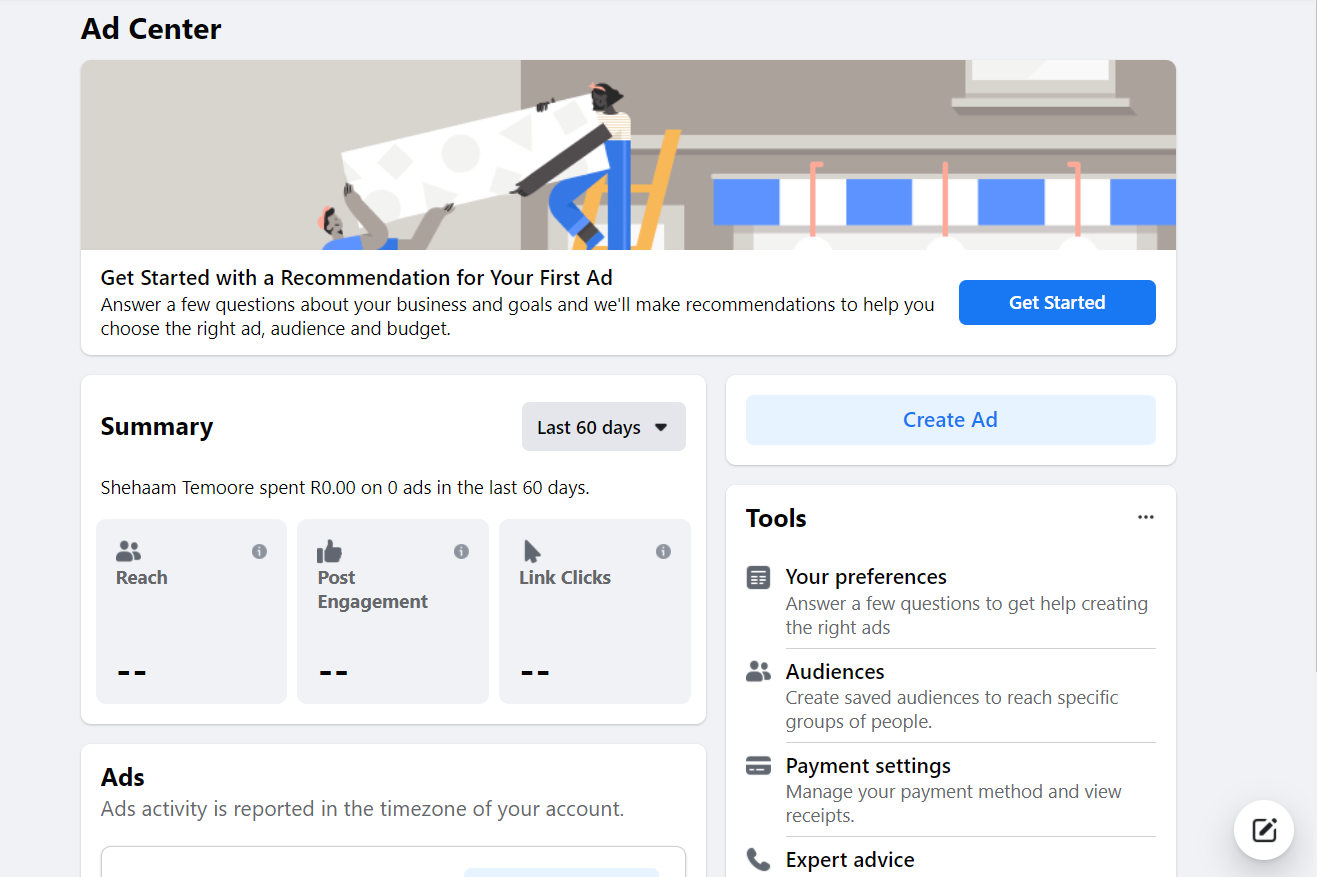
Ad Center
The ad center tab is where you are able to manage ads created from your Business Page. It allows you to view and edit results for all ads you are running.
Page Quality
You can check if your page has any restrictions or if it’s violating the
Facebook community standards.
Edit Page Info
The page info section is categorised by:
General: Your page name, username and description of your business and the products or services you offer.
Categories: Helps people find your page by choosing one or more categories that best represent your brand.
Contact information: Here you can include your contact numbers (telephone, cell and WhatsApp number), a business email address and your website link.
Location details: Address, city and area code.
Service areas: If you travel to provide goods or services, you can define your service areas by selecting up to 10 neighbourhoods, cities or regions.
Operating hours: Your business hours can be updated to show when your location is open.
More: Additional details like product information, privacy policies and terms and conditions can be added here.
Price range: You can specify what price range your products or services fall within.
Other accounts: This allows you to connect other social media accounts you have.
You aren’t restricted to the amount of detail you wish to include, you can add as much or as little information as you want to.
Settings:
Facebook’s page setting section allows you to cover all bases, from general settings all the way through to the page layout and advanced messaging settings.
General Settings
The general settings include preferences like page visibility, profanity filters, age and country restrictions, messaging, page tagging and much more.
Messaging
You can set up specific messaging features, FAQ’s and autoresponders and edit preferences for Facebook Messenger and Instagram.
Templates and Tabs
Templates and tabs allow you to choose an option that best suits your page. It offers default buttons and tabs that can easily be rearranged and reordered with a quick click and drag.
Check out the 10 different Facebook templates you can choose from.
Page Notification Settings
Control which page notifications you receive about your Facebook Business Page. It will give you the option of either turning off all notifications or limiting the amount of notifications you receive on a daily basis.
Advanced Messaging
In addition to the general messaging settings, Facebook lets you manage settings for bots and other features within the advanced messaging section.
Page Roles
If you have a team each responsible for different tasks, you can assign page roles according.
Admin
Will have full access to the page and can manage all aspects of the page.
Editor:
Page editors have similar access to admins, they just aren’t able to assign new page roles.
Moderator:
Can send messages, respond to comments and delete comments, create ads and view insights and is able to see who created a post or comment.
Advertiser:
Is able to create ads, see who created a post or comment and can view insights.
Analyst:
Has the most limited access of all page roles. They can only see which admin created a post or comment and is able to view insights.
People and Other Pages
Lets you see all the people or pages who like your Facebook Business Page.
Instagram:
Connecting your Instagram allows you to manage both social platforms in one place.
WhatsApp:
People can easily connect with you or reach you via the WhatsApp Business account connected to your page.
With it being the largest social media network, and, judging by the rate at which it’s growing, the foreseeable future has plenty more changes in store.
If you need help
setting up and optimising your Facebook business page, chat with us.
There’s no denying that in order for a website to be kept in working condition, it needs to be
well maintained.
We understand better than most how important this is to any business.
And while
website maintenance pricing factors in the type of website you have, how experienced the design company is, and the extent of maintenance you’ll need; there’s still the all-important question…..
What is included in website maintenance?
A
website maintenance package will typically include a few standard services:
Updating or adding new content
Theme and plugin updates
Optimisation
Design changes
Security scans
These are all crucial factors that keep your website running like a well-oiled machine.
Lets dig a bit deeper, so you can have a well-rounded understanding of all the factors and how they work together.
Website updates and changes
Updating Content
In order for your website to remain relevant, it needs to showcase the latest and
most relevant information.
Content changes can include anything from uploading fresh, new content to your blog regularly to contact details or address changes.
Social Media Integration
Ensuring that your website displays your latest social media content and that all new social media buttons are integrated is important when trying to engage your audience on social media. It also helps increase your
website traffic.
Theme and Plugin Updates
A website doesn’t run like a machine, you need to dedicate time to regularly keeping all the elements up to date.
Content Management Systems (CMS), like
Joomla and
WordPress, offer various website plugins and themes that need to be updated on a regular basis to improve the security and performance of your website.
Website testing and improvements
Design Changes
When was the last time your website had a bit of a makeover?
From time to time, a website can benefit from layout changes or a complete redesign. This will help you keep up with the latest design trends, and attract more visitors.
Image Resizing
The larger the image size, the longer it will take to load the page. Image resizing is essential for
page speed optimisation.
Optimisation
One of the major goals of a website is to make the user experience as effortless as possible. An optimised website will help you achieve that goal.
Website backups and monitoring
Security and Performance Scans
Security breaches and hacks can be a nightmare to deal with. It can make your website unsafe for visitors, cause you to lose some, or, even all of your website information.
And, this is why
regular website backups, monitoring, and security measures are critical to protecting you, your business and those visiting your website.
Do you need help with your
website maintenance requirements? Sign up for one of our
package options and we’ll take care of the rest!
The turnaround time for a website can vary anywhere from days to weeks, or even months.
To accurately answer
how long it takes to build a website, there are a few factors one would need to take into consideration:
Who will be designing the website
The type of website you’ll need
How you want it to look
Create a Clear Plan
First, you need to invest some time into properly planning the project.
Do your research and compile a checklist. Have a look at what is currently out there, what your competitor’s websites look like, and what exactly you are looking for. And, decide whether you will be designing the website yourself or whether you’ll hire a professional to get the job done.
Having a clear idea of what you want and need can shave off a chunk of the time spent on creating your website.
Once you’ve crossed the first hurdle, you’ll be one step closer to finding out
how long it will take to create a website.
Doing it yourself
How long does it take to develop a website yourself?
If you’re technically inclined, have experience with HTML code, and the skill to build a website from scratch, then a DIY website is an ideal choice.
This of course depends on your technical skills, the type of website, and how much time you have available each day to spend on it. Taking all of this into account, building a website yourself, from scratch can take anywhere between
a few hours to weeks.
Pros:
If you’re able to build it yourself, it can potentially save you money and you’d be able to create a website exactly how you’d want it to be.
Cons:
It can become a time-consuming task that takes attention away from other aspects of the business.
And, if you’re not able to create the website yourself, you’d have to invest money to get it done professionally. This could mean additional time wasted.
Using a website builder
Website builders are popular and quick and easy to set up. If you’re not clued up with coding languages, then a website builder may be the next best alternative for you.
How long does it take to build a website with a website builder?
Because website builders are template-based, there’s usually a wide selection of templates to choose from for both service and product-based businesses.
This can significantly narrow down the time it takes to create a website. You can expect it to take anywhere from
a few hours to at least two weeks.
How to build a website with a website builder:
Choose the template and theme that best fits what you do.
Start customising it by adding your brand colours, images, and information.
Install any necessary plugins.
Hit the publish button.
Pros:
No coding or design skills required
Cheap and fast
Cons:
Not recommended for professional businesses
Slow loading time
Not ideal for SEO
Limited pages and features
Hiring a professional
Hiring a professional often seems like the most practical option. Keeping in mind, no two web design companies are the same. While some can create a website within a short timeframe, others may need more time to deliver the final product.
How long does it take to design a website when hiring a professional web design company?
The time it takes a professional company to design a website is largely determined by the type of website, features, and functionalities you require.
Web design companies generally follow a few processes:
1. Briefing - where they will gather all the necessary information about your business, website requirements, and goals.
2. Production - when the website is assigned to a designer and goes into production.
3. First draft - when the first draft gets presented and you can give feedback on any changes to be made.
4. The final product - based on your feedback, changes will be implemented and the final product will follow.
In its entirety, it can take a professional web designer 5 days to 8 weeks to design a website.
Why hire a professional web design company? What are the pros and cons of doing so?
Chances are, with a professional web design company, you will get a website that won’t only look the part, but will also function as it should.
But not only would they be able to create a website that can attract an audience, they can also help market your website for you.
In conclusion
In order to determine how long it will take to create a website, you need to think about your needs and the goals you wish to achieve with the website.
The factors outlined largely contribute to and go hand in hand with the amount of
time it takes to build a website.
Saying a website doesn’t need to be maintained is like saying a car doesn’t need to be serviced.
Many don’t consider website maintenance to be a priority. In fact, we’ve done our fair share of explaining that once designed, a website does NOT run on autopilot. In order for it to function properly, you’ll need to invest in a website maintenance service.
Truth is, no matter how big or small your website is, it needs to be maintained and updated on a regular basis.
But why is website maintenance so important, and, how much does website maintenance cost?
Let’s take a closer look at all there is to know about website maintenance, why website maintenance services are important, and website maintenance cost.
What is website maintenance?
Website maintenance essentially refers to the process of ensuring that your website is regularly checked for any issues and that everything is up to date and well maintained.
Why website maintenance services are important?
A website’s kind of a big deal, more so if you’re relying on it to help bring in business.
It’s your little corner on the internet people visit to learn more about your business and the products or services you offer. And more importantly, to make contact with you.
It betters the user experience
User experience is everything.
There’s no use getting people to your website, only to have them leave because they’re finding it difficult to navigate their way around your website.
First impressions last, and if you’re not creating a good enough one, chances are you’re likely to lose out on potential business.
An outdated website, and particularly, one that is not working as it should will discourage, rather than encourage people from taking action on your website.
A maintained website keeps users informed
Your website should always display the latest, and most up-to-date information about your business and its products or services.
Frequent website maintenance checks and updates will help keep people informed about any changes, such as:
- Changes to your address and contact details
- New products or services
- Events, promotions and specials
SEO
If your website is updated on a regular basis, Google will crawl your website more frequently. This will, in turn, contribute to better SEO results.
Improves your site’s security
Attacks and hacks are all too common. And the damage to your business can potentially have a long-term effect. By doing website maintenance on a regular basis, hackers are less likely to attack your website.
Website maintenance cost
The cost to maintain a website largely depends on, a) the needs of the website, and b) the level of expertise of the web design company. You can expect to pay anywhere between R299 - R10 000 a month.
Website maintenance prices will differ from company to company; some will charge a once-off fee, others may quote you an hourly rate. And others may have website maintenance packages to choose from.
A website isn’t merely for show, it’s a long-term investment that requires ongoing attention.
With this simplified website maintenance checklist, you can help keep your website on track and in tiptop shape.
Why choose Web Partner for your website maintenance needs?
We offer customised website maintenance packages,, depending on the need of the business and the size of the website. Our package options ensure that your website is frequently updated and will save you from having to fork out money for a complete redesign.
What does our monthly website maintenance include?
48-hour turnaround time
All updates and maintenance requirements are done within 48-hours.
A dedicated designer
We assign a dedicated designer to your website.
Adding new content and pages
The appointed designer will be responsible for adding new pages and content to your website.
Update Content
All latest news, blog articles, images and videos on your website will be updated and maintained.
Social Media Integration
The latest social content and new social media buttons will be added to the website.
Design Changes
We will implement design layouts and changes where necessary.
Image Resizing
Images will be resized for page speed optimisation
Optimisation
To improve the page speed, mobile layouts and user experience, we will ensure the website is properly optimised.
Security and Performance Scans
Your website will be scanned for security vulnerabilities and all necessary updates will be implemented.
Why hire a digital marketing agency when you can do it yourself, right? NO! HOLD. THAT. THOUGHT.
At first glance, marketing seems easy. But with a long list of options including SEO, google ads, social media, email, and content marketing; the digital jargon can leave you feeling confused and slightly overwhelmed.
It’s ok and perfectly normal – we see it all the time.
Truth is, digital marketing is an umbrella term representing different marketing tactics offering businesses the potential to grow in heaps and bounds.
But that growth comes from a particular skill set, a level of experience, time, and resources that you may otherwise not have to carry out your marketing requirements.
In short, the right digital marketing agency can be an asset to your business.
But if you’re not yet convinced that a marketing agency is worth hiring, let's look at why we reckon you should.
EXPERT KNOWLEDGE
In the same way, in which you’re skilled in your line of work, a marketing agency comes equipped with experienced and qualified experts who have a clear understanding of marketing techniques, know their CPC’s from their CPA’s and can help you achieve your business goals.
HELP YOU STAY RELEVANT
The digital world is fast-paced, there are always new developments and trends to keep up with. Agencies are expected to keep up with all the industry changes, customer markets, their target audience, and their competitors to deliver the best possible results.
FOCUS ON RUNNING YOUR BUSINESS
Let's face it – running a business is difficult as is. Many time-consuming tasks carry a lot of weight and demand your attention and focus.
Enlisting the help of an agency will lighten the burden and allows you to focus on important more matters: running and growing your business.
SAVES YOU TIME AND MONEY
While it can be argued that the cost to hire an agency doesn’t come cheap, there’s a bigger picture to look at.
When you weigh up the cost to acquire digital marketing skills or hiring an in-house person(s) vs outsourcing to an agency, you’ll find the latter to be more affordable in the long-run.
Not only do you cut out the cost of a potential full-time salary and employee-related benefits, but you also determine when and how much you wish to spend.
YOU GET MEASURABLE RESULTS
In the digital world, all things are measurable. And the best way to determine what does and doesn’t work is to measure the results. An agency will help you gain the necessary insight about your business and its performance as well as your audience and what they find most useful.
Now that we’ve established that an agency is well worth hiring, here’s what you can expect to get from a digital marketing agency:
They will conduct market research, assess your needs, and plan and execute a suitable strategy.
Provide advertising solutions for various platforms, including Google, social media, etc.
Manage and optimise your search engine ranking.
Research, plan and create content to engage your audience.
Manage your social media accounts.
Track and measure your results and goals.
Social media has trickled into nearly all aspects of life and business. Collectively, the platforms are rife with 3.9 billion users looking to share their views and opinions, keep up with the latest gossip and news, and brands wanting to connect with their target audience.
With new platforms springing up and the number of active users growing by millions yearly, the social media bubble is evolving and expanding at a rapid rate. And they are showing no signs of slowing down anytime soon.
How the Platforms Compare
Lets take a look at how the top social media platforms, and some that are flying under the radar stack up against one another.
Facebook
Leader of the billionaire club, Facebook currently has approximately 2.7 billion monthly active users worldwide. Undoubtedly the largest social network. Since launching in 2004, Facebook serves as a way for people to establish connections and appeals to younger and older generations.
Despite its goal to prioritise connecting people with people, the platform is also home to millions of businesses, allowing them to connect with their target audience.
But not all is rosy in Facebookville, companies have rallied to boycott Facebook ads and founder, Mark Zuckerberg has been making headlines for all the wrong reasons.
Drama aside, Facebook is continuing to peak above all other social media platforms and will leave their mark in history once it hits the 3 billion user mark.
Snapchat
Snapchat is an image and video messaging app with 397 million active users, and currently ranking as the 12th most popular social media platform.
Through filters and lenses, the platform brings a different kind of augmented reality to its users. And their uniqueness lies in the app’s ability to have messages that have been shared disappear almost immediately after it has been opened.
But with its users on the decline and the app rivalling with social media giants like Facebook and Instagram Stories, there are concerns of whether the future of Snapchat looks promising.
YouTube
Hot on Facebook’s heels with just over 2 billion active monthly users, YouTube is the biggest video platform and an information hub with millions of channels.
The platform has come a long way since its first video, “me at the zoo” was uploaded in April 2005. Since Google purchased YouTube in 2006, it has succeeded in getting eyeballs to the platform and is known for more than just the “influencers” and “content creators” it is home to.
With people worldwide spending nearly 1 billion hours watching YouTube videos daily, and the platform transforming into a subscription-based network, offering ad-free content, music and so much more, bigger and better things seem to lie ahead for the video sharing platform.
WeChat
WeChat, the messaging app equivalent to WhatsApp is dominating the online space in China. The Tencent owned company boasts over 1.2 billion users, making it the 5th largest social media network out there.
The range of services offered through WeChat functions as a whole suite of apps; with offers ranging from games integration, WeChat shop and payment and WeChat Moment (Newsfeed) to name a few.
WeChat is proving to become a powerful force to be reckoned with.
Reddit
Living up to its slogan, “the front page of the internet”, Reddit has successfully made a name for themselves as the platform to discuss and curate all kinds of content on the internet.
By 2020 their user base was well over 430 million active users, in comparison to the 330 million users they had in 2018. The all-in-one media, micro-community and culture platform has given a different meaning to the word “community” in the digital age.
Instagram
As one of the fastest growing and most used platforms, Instagram is great for developing a personal brand and connecting with an audience. With strong ties to Facebook and an active user count of 1.08 billion members, the platform has drastically evolved and became so much more than just a photo-sharing network.
Appealing to a younger audience and with features such as Instagram Stories and Reels, Instagram is standing out as one of the more versatile platforms.
Twitter
With 326 million active monthly users and roughly 500 million tweets sent out each day, Twitter has steadily climbed the social media ladder. As of 2019, the platform reportedly bagged 1.5 billion dollars in revenue.
But just like Facebook, Twitter has been slammed with its fair share of controversies, which has resulted in a social cleanse of more than 70 million fake accounts being closed.
But this hasn’t stopped Twitter from being one of the biggest and most favoured social media platforms.
TikTok
We can all agree, TikTok was the worthy winner of most popular social media platform in 2020. Despite all the bad publicity regarding privacy breaches, their monthly active users jumped to a whopping 800 million, making TikTok the fastest growing social network in 2020.
Messenger
If we were to sum up Facebook Messenger in one sentence, it would be: an enormous platform that is radically expanding. The app has not only made it easy for people to connect on a personal level, but it also allows for easy and convenient business transactions.
Next to Facebook, Messenger has been the most downloaded app and currently stands at 1.3 billion monthly users. The app is said to reach nearly 2.5 billion users by 2021.
WhatsApp
WhatsApp offers a fast, convenient, and affordable way for people to communicate. The messaging app was created as an alternative to traditional methods of messaging and is a play on the words “what’s up”.
In 2014 Mark Zuckerberg paid megabucks for the app (19 billion dollars) and to date, the platform has acquired 2 billion users worldwide.
QQ
With 694 million users, QQ, the social messaging app that originated in China and belonging to Tencent, has been dubbed the closest thing to Snapchat.
Their teen-friendly features such as avatars and animations, makes them appeal more to younger audiences than it does to older generations. QQ appeals far more to younger audiences than it does older generations.
While the app is not widely known outside of China, it has gained widespread popularity within China.
Weibo
The social media landscape in China is huge. With as much as 550 million of those belonging to the popular microblogging app, Weibo.
Said to be the Chinese Twitter, Weibo has claimed the title as the second largest social network in China.
Like WeChat, brands use Weibo as a social media marketing tool to market their products or services.
Pinterest
Pinterest has proven to be a promising platform to help showcase your personal brand. To date, the platform has accumulated over 200 billion pins, and a vast majority of its users are said to be female.
The social “bookmarking” site has an estimated 367 million users. Described as a positive and uplifting platform, Pinterest is getting more and more attention and users outside of the United States.
Conclusion:
2020 saw social media platforms experience a whirlwind of highs and lows. Networks like Facebook and TikTok fell victims to public scrutiny as concerns about data privacy were raised.
But long-term predictions suggest there is lots of room for growth left. With as much as half of the world’s population utilising social media, and features and functions getting better and better, users and brands are looking to benefit from plenty more in the future.
(Statistics sourced)
While our optimism and hope for a better 2021 runs high, we are still trying to wrap our head around the year that would go down in history as the plot twist no one saw coming.
Lets be honest, the pandemic (in some way) still feels like a dark cloud lingering over us, but, our positive spirits have been restored and we are stepping into this year with our heads held high. And, we are giving ourselves a pat on the back for surviving 2020, and so should you!
But before we rush to hit the reset button, lets take a look at what 2020 had to offer (other than a virus, of course).
WEB PARTNER turns 6
In 2014 we launched with a small team and big dreams. Six years later, and we can proudly say we’ve made our mark as one of South Africa’s best web design agencies.
We are now a team of 30 with talent spanning across web design, google ads, SEO and social media.
We’ve also designed over 10 000 websites and have pocketed many happy, satisfied and loyal clients that we are truly thankful for.
Bonus: we’ve met some amazing and interesting people along the way.
TIKTOK takes centre stage

Oh TikTok, you’ve quite literally, changed the world. The humour and entertainment that the short-format video platform provided was exactly what we needed during a chaotic and controversial time.
But that’s not all - not only did TikTok claim the spot of most downloaded app in 2020, but it levelled status with Facebook, Instagram and WhatsApp when it became the fastest platform to reach over a billion downloads.
And while it may be the platform most popular with “Gen Z”, it was a hit with all ages during lockdown.
Online SCHOOLING
With schools being forced to close, students, teachers and parents had to adapt to a new reality of learning: online education.
But this wasn’t the reality for all. For some, the digital divide made it difficult for them to be connected and to participate in e-learning.
Many considered the year a write-off, but all in all, it is said that students adapted well to the change and managed to progress rather than regress.
The ZOOM boom

Who would’ve thought that our work and personal lives would intertwine and unfold via a video-conferencing app?
The app came in handy for work and classroom meetings, and was also deemed the hubspot for social gatherings, parties and even date nights.
Thanks to Zoom we were able to feel a little less isolated and a bit more connected, even if it were from a distance.
ONLINE SHOPPING skyrockets

They say you need to be where your customers are, and online is exactly where the vast majority of us found ourselves during lockdown.
Prior to lockdown, e-commerce was already on the rise, but 2020 saw customers shopping with far more intent. With more and more purchases being made, there was a ripple effect on the courier services.
Despite it being a trainwreck of a year, with lots of lessons and challenges, there were also eye opening moments and moments of opportunity that we’re thankful for.
We wish you all the best for 2021. Remember, believe in yourself and be kind!
Web designers play an important role in bringing a brand’s vision to life and getting their message across. Imaginative, creative and well-versed in technical elements mildly sums up their talent. But while most of their day may consist of design work, a typical day for a web designer entails more than, well, web design.
So, what does a day in the life of a web designer look like?
First…. Coffee
We all appreciate a good cup of coffee to kick-start our day, it’s essentially the antidote to those early morning woes. Coffee = functioning on a better level.
Planning
For a designer, failing to plan is planning to fail. Because they’re usually working on more than one project on a given day, they need to set time aside to plan their daily schedule.
Admin
It may not always be the most enjoyable task, but it’s one that needs to be factored into our daily schedules. Admin for a designer can range from client communication (emails, telephone calls) to paperwork such as status and progress reports.
Briefings
The scope of a project is outlined in briefing sessions, this can take place between a client and the designer or the designer and a project manager. This is where they’ll get insight into the requirements for each project, the goal as well as the deadline.
Designing
A large part of a web designer’s day is dedicated to design work. This is where they work their magic and piece the puzzle together to meet the client's needs. It is also the portion of their day that requires the most focus and attention to detail to ensure they’re producing fully functional websites.
Quiet time
In between all the chaos and craziness, quiet time is necessary for a designer. This helps them with any creative challenges they may be facing and is also an ideal time to think out new ideas and solutions. People have different preferences, so while some may enjoy listening to music during quiet time, reading a book or playing games may help others.
But more importantly, they’re human, and we all need a break, even if only for a few moments.
Research
Web design is a fast-paced industry that is constantly changing and evolving. This means designers have to keep up with all these changes and trends, not only to expand their knowledge but to also maintain a high level of customer satisfaction. And this helps web designers keep up or stay ahead of the competition.
Brainstorming
Getting together as a team and having brainstorming sessions allows you to think and see things from a different perspective. It’s also an opportunity to get feedback from your team, allows designers to creatively feed off one another and can have a positive impact on all other areas that a designer’s day typically consists of.
If the idea of a website and having to put one together stresses you out, don’t worry, you’re not alone. We’ve worked with a couple hundred clients and designed over 10 000 projects, and let me tell you - we’ve had many people look at us as if we’re speaking a foreign language when talking about website elements.
The truth is, a website really isn’t all that scary. If you look past coding and the more technical aspects, it’s actually a fun process to see come to life. Back when websites were in the infancy stage, we didn’t have what is widely known today as website builders such as Wordpress, Joomla, Wix and Squarespace to name a few.
Not only have website builders become an essential part of putting a website together, but they make the design process so much easier.
But what exactly is a website builder, how do you choose one and how does a free website builder compare to a paid website builder?
Don’t stress - sit back and relax while we walk you through all there is to know about website builders for small business.
What is a website builder?
Website builders are content management systems (CMSs) in which users can create, edit and publish a functional web page using visual, menu-based tools instead of writing code. (source: Google)
If we consider the benefits of a website builder, it makes sense why it’s important, especially for small businesses.
Benefits of a website builder:
- It works on a drag-and-drop technology and an interface design that is user-friendly, so technical skills is not a requirement.
- Because your website files are hosted on a server, you can access and edit it anytime and anywhere with your login details. Added bonus: you won’t lose your files.
- They offer many different template options.
- You can DIY (keeping in mind there will be specific functions, tools and applications that add to the functionality of a website that you may need a professional designer to assist with).
- You’ll be able to have a website up and running in no time.
- Cost-effective
- It allows you to manage and maintain your website
How to choose one?
From Joomla and Wordpress, to Wix, Squarespace and all other website builders on the market, choosing one can be tricky if you’re not sure what to look for. Sometimes a decision is based on what is needed vs which website builder closely matches those requirements, other times it can boil down to popularity. Look at Wix, they’re everywhere and make their existence known across the internet.
Here’s a couple of suggested pointers to look at before making your final decision:
- Free trial: check whether you’re able to test out a free trial. With the exception of some limitations, most website builders offer a free trial/plan.
- Price: get all the necessary pricing details and check the fine print on any extra costs.
- Support: if you have a website, you’ll most certainly need support (phone, chat, email etc). Be sure to test out the support options they offer before committing to a paid plan.
- Features: this will of course largely depend on the purpose and goal of the website. Will it be for personal or professional use? Do you need a shopping cart to sell products? And check whether they offer decent blogging systems and images galleries, mobile-friendly designs and password protected pages.
- Themes: website builders usually offer a number of themes to choose from, make sure the theme options and its functionalities meet your requirements.
How a free website builder compares to a paid website builder:

The lower the cost, the better - we get it. But although free website builders are great, they're basic and come with limitations. And if the goal is to use the website in a business related context, it may not be the best option.
2000 - the year when boy bands reigned supreme, tie-dye and tube tops were fashionable and computer viruses caused widespread panic. Two decades later, and what a momentous time to look back at.
Let’s take a look at some of the things turning 20 in 2020.
The world’s first camera phone was released
It’s hard to imagine a world without the device that allows us to capture every moment of our lives. From selfies, to cute pets or cringeworthy throwbacks. Although camera phones are common today, it wasn’t 20 years ago.
In 2000, the first commercially available cellphone was released and was essentially the start of what is known as MMS today. The J-SH04 was said to have a mere 0.1-megapixel resolution.

Bill Gates stepped down as CEO of Microsoft
A prolific entrepreneur who achieved great success from a young age, Bill Gates is widely known as one half of the brains behind the Microsoft Corporation and for his philanthropic endeavours.
Microsoft is the tech titan founded in 1975 that developed the many software programs used today and helped Gates gain his billionaire status. After many years as both CEO and chairman, the year 2000 saw Bill Gates step away from his CEO position at Microsoft, while remaining chairman.

The dot.com bubble burst
2000 seemed to have been the year that kept giving, both good and bad. The dot.com bubble, also known as the internet bubble, was the rapid rise and fall of internet stock prices that ultimately led to a massive crash in the stock market in 2000.
Sony PS2 was released
The PlayStation experience was every child’s dream in the 2000’s. Following its launch in 2000, the PS2 offered an experience players wouldn’t easily forget. And it quickly became the highest selling and most played console in gaming history.

The final original comic strip of Peanuts was released
Peanuts was a long-running comic strip created by Charles M. Schulz in 1950 released its 17 897th strip on 13 February 2000, one day after Schulz passed.

X-Men was released and paved a path for Superhero Movies
Notably the movie that paved the path for all other Superhero Movies that followed, X-Men premiered in July 2000 and starred Hugh Jackman. The film was a huge success and received raving reviews. Following its success, there were many sequels and spin-offs that have since featured numerous A-listers.

Friends was the most popular sitcom
Who can forget the hit series, Friends that starred many famous faces, including Brad Pitt, Reese Witherspoon, Bruce Willis and Tom Selleck to name a few. The popularity of the show led to the “Rachel haircut” being the go-to hairstyle.

The sims was released
Simulation game lovers will agree that the release of The Sims in 2000 was the kick-off for all simulation games thereafter.
The Nokia 3310 was the best-selling phone
Before all the fancy smartphones existed, the Nokia 3310 and its relative, the 3390 were the cool kids on the block. Millions were sold worldwide, and it became one of the most iconic phones to have existed.

Razor scooters were the most popular toy
The way of life in the 2000’s compared to 2020 are worlds apart. Back then, outside play outweighed a cellphone or video games. And every child either owned or wanted a razor scooter.
Fun fact: Not only was it named toy of the year, but sales skyrocketed, with more than 5 million scooters purchased in the first 6 month of launching.

The millennium bug didn’t bite
December 31st, 1999 will not easily be forgotten. As everyone awaited to ring in the year 2000, it was feared that computers might interpret 00 as 1900 and not 2000.
Napster made headlines in the music industry
Today it’s quite easy for us to download, watch or share videos and music. But back in 2000, the hundreds of sites we can access today did not exist. Napster made a name for themselves when they allowed music enthusiasts to illegally download MP3 copies of records.

Survivor debuted
When you’re granted the opportunity to compete for 1 million dollars, stepping into the unknown with complete strangers is a challenge worth the try. Since its debut, Survivor went on to bag several Emmy Awards and is considered one of the best shows of the 2000’s.

Mobile devices quickly shifted from optional to a societal must-have. Statistically it is said that the number of mobile users in South Africa will grow to 39.06 million by 2025, that’s close to 800 000 more users than there currently are in 2020. With the year upon year increase, businesses are having to ensure they’re keeping up with industry standards to meet their audience where they are.
Mobile-friendly web design, unlike traditional web design is formatted and designed to be mobile responsive. It largely contributes to the way people interact with a business and the overall interest they’ll show in it.
Here are a few reasons why mobile-friendly web design is important:
Your audience uses mobile devices
Smartphones are all around us. On average, a household contains between 3-5 electronic devices, and over 50% are mobile devices. This means more people are likely to search for your product or service on a smartphone and, a mobile responsive website will help you better the user experience.
Helps build trust
Mobile-friendly web design helps users access a website with ease. A website that is not easily accessible will result in potential customers losing interest and confidence in your brand.
Google ranking
Mobile-friendly web design is one of the top factors that Google takes into account when deciding how to rank your website. In 2018 Google made an announcement stating that they’ll prioritise crawling mobile versions of websites over desktop versions. This means, a website designed with mobile in mind will have a positive impact on your overall Google ranking.
Clients may find it difficult to contact you
A responsive website will adjust to the screen size the user is viewing it on, this makes it easy for them to view or find the information on a website. When a website is not mobile responsive, people will find navigation difficult and this will in turn make it difficult for them to get in touch with you.
Bottom line? Mobile-friendly web design has a positive effect on YOUR bottom line. When people have a negative experience with your website, they’re less likely to show an interest in your brand or to recommend your product or service. And you’re far likely to lose potential clients to your competitors.
To check if your website is mobile-friendly, use Google’s mobile-friendly test. Need a web design company who can help you with a mobile-friendly website? Partner with us!
Google has been no stranger to scrutiny or skeptics who wonder whether Google ads are worth it. But business has evolved, and competition has steadily increased. And the law of the 21st century is simple – for a business to make money, they need to spend money.
Google ads have proven to be a cost-effective form of advertising that allows you to reach your intended target audience.
Below we delve into 6 different ways to advertise with Google.
Search Ads
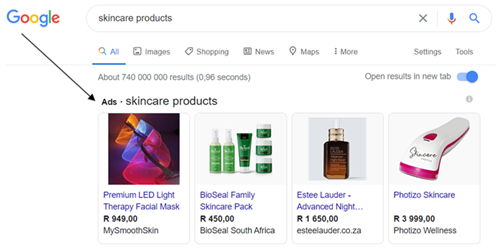
Search ads are text-based ads that appear above or below organic searches on the Google search engine results page. They are easily identifiable by the “ad” text displayed next to a web address, as indicated below. Search ads allow you to target people specifically looking for your product or service and helps drive targeted traffic to your website.

Display Ads
Google’s Display Network helps you showcase your ads on third-party websites based on user behaviour, interests and more importantly, the context of the website it is being displayed on. Display ads can come in the form of text, static banners, or animated banners and, unlike search ads that are keyword driven, display targets a higher bracket of users to help build brand awareness.

YouTube Ads
Anyone who has ever watched a YouTube video has fallen prey to the ads that pop up before or during the video, or the text ads that display when watching a video.
As a Google owned search engine that accounts for almost one third of internet users and is the second largest search engine, YouTube ads allow you to target audiences according to the specific search terms people are searching for.

Shopping Ads
Google shopping ads are the product listing ads we see at the top of search engines that allows advertisers to showcase their products.
These ads include: all relevant product information, images, pricing, and product reviews.
Gmail Ads
Gmail is a product owned by Google that grants businesses the opportunity to advertise to targeted audiences. In comparison to other ad placements, the cost to advertise is lower, as is the competition and it’s an ideal option to help create brand awareness.

Local search
Local search, also known as Google My Business or your Google Business Listing is a product that allows you to highlight more information about your business, including trading hours and address. Through local extensions and location targeting, brands can reach nearby searchers.

WHICH METHOD IS MOST SUITABLE FOR YOU?
To determine which of the 6 methods will be best suit you, there’s some factors that need to be taken into account:
Target audience
Consider where your audience is likely to take action.
Your budget
A limited budget will require focus on more targeted options like search advertising or remarketing. If you have a limited budget, you need to focus on more targeted options like search advertising or remarketing.
If you have a bigger budget and wish to reach a broader audience, your marketing mix can consist of search ads, remarketing, Gmail, Display and YouTube ads.
For e-commerce websites, shopping ads would be your best option.
Your goals
If the goal is to generate leads, search and search partners will be the best suited option.
For brand awareness, Display and YouTube ads will offer a good return on investment.
Google is a results-driven platform that will allow you to generate leads, sales and drive targeted traffic to your website. But for you to leverage from the opportunities that Google has to offer, it’s important for to have a good understanding of how each of these options work.
Need some help? Get in touch with our team of experts!
Content writing vs copywriting, what's the difference and why does it matter? Content is all around us - we see it in the material we read, witty ads that encourage people to buy, videos we find interesting, and even in the memes that make us laugh.
These concepts and copy stem from two categories that have been long-standing in the advertising industry: copywriting and content writing. But what exactly is content writing and copywriting?
Let's start by clarifying the obvious, they are NOT interchangeable terms. There are notable differences that allow you to tell a copywriter from a content writer.
OBJECTIVE
The most distinctive difference between the two is the purpose it serves. While copywriting aims to sell, content writing focuses on informing, educating, and entertaining audiences.
Copywriters take the product or service you sell and merge it with your brand's persona to appeal to a buyer's emotions and to drive sales.
Content writers are known to create content that aligns with a brand's voice and is clear in its purpose to help understand a brand.
But although their objectives may differ, both are driven by the goal to entice audiences, whether it is to convert them into sales or to pique interest in a brand through valuable and insightful content.
ROLE
Copywriters are professionals devoted to producing material centred around the marketing goals of a business. Content writers on the other hand aren't necessarily limited to professionals; it can include authors, bloggers, or even CEOs who are capable of producing content.
TYPES OF COPY
The internet birthed an era that's seen marketing methods evolve drastically. Copywriting, which was traditionally recognised in advertising has since shifted and come in varying forms, including:
Slogans
Taglines
Email marketing campaigns
Press releases
Online ads (social media campaigns, Google advertising)
Offline ads
Scripts for video, radio, or TV commercials
Brochures
Web content
SEO content
TYPES OF CONTENT
Much like copywriters, content writers are universally recognised for their ability to produce content across a multitude of channels, including:
Blogs
Social media
Newsletters
Books and E-books
Podcasts
Magazine
Radio and TV
SEO content
In a world where content and copy is constantly evolving, having both content writing and copywriting as part of your strategy will contribute to successfully meeting your goals.
In a world that has no shortage of devices that come in many different sizes, web design had to evolve and adapt to better meet the needs of the users at the other end of these devices. For those familiar with the term responsive web design, you’d know that a responsive website can kill many birds with one stone.
Lets dive into the concept of responsive web design and why it is important.
What is responsive web design?
In short, responsive web design refers to a way of designing a website that allows it to adjust to the size of the device users are viewing the website on. These include mobile phone, tablet and desktop viewing.
Why is responsive web design important?
User experience
When it comes to a website, the user experience is crucial and it’s important that they’re able to navigate their way around your website without any issues from any device.
Google ranking
A responsive website helps you get into Google’s good books. When Google sees that you have a high bounce rate (the percentage of people exiting your website), you’ll be severely penalised and your rankings - both organic and paid will drop.
Loss of potential business
Your website will help you generate business, but when it’s not easily accessible to a user on their preferred device, people are far more likely to lose interest and this will lead to a loss of potential customers.
Credibility
Your website is more than just the destination that allows people to view your products or services. It’s the digital face of any business. A website that is not responsive can create an unprofessional perception of a business, which can result in it being stripped of its credibility as a service provider.
Increased mobile traffic
Before responsive web design, two variations of a website was the norm - one that accommodates desktop users, and another specifically aimed at mobile users. But two versions of something that serves the same purpose can be both costly and time consuming in the long-run. Now that people are utilizing their mobile devices much more to access information they’re looking for, responsive web design makes it easier for you to reach mobile users.
Responsive web design is not a concept that is likely to die down. With the constant rise in the types of devices available to us, responsive web design needs to be forward-thinking. This will ensure a positive user experience, help with your ranking, credibility and traffic that can result in potential business.
From recipes to tutorials, vlogs and explainer videos to name a few; video content, in recent years has been on the rise and has shown no signs of slowing down anytime soon.
TikTok, a predominantly GenZ platform has taken the world by storm with short-form videos and made quite the name for themselves. And more recently, Instagram started making waves with their newly launched feature called Reels that have left many wondering, will Instagram be giving TikTok a run for their money with Reels?
Here’s what you need to know:
What is TikTok?
TikTok, formerly known as Music.ly is a social network launched in 2016 that allows you to create, edit and share short-form video and follow other accounts. Their aim is to inspire creativity and bring joy with short, fun and trendy videos. To date, the app has accumulated over 1 billion users worldwide, most of whom are aged between 16 and 24.
What are Instagram Reels?
Much like TikTok, Instagram Reels is also a short-form video feature launched by Instagram that allows you to edit your reels by including music, adding filters or changing the video speed.
What’s the difference between TikTok and Instagram Reels?
The main difference between the two is the length of the videos. While TikTok allows up to 1 minute videos, Instagram Reels are limited to only 15 second clips.
Secondly, although Facebook stated the launch of licensed music, no announcement has been made on what type of music will be permitted on the platform.
Many have dubbed Reels a replica of TikTok, and believe it will live up to or exceed TikTok’s standard. This begs to ask the question - should TikTok be concerned about the threat Reels poses?
Why Reels are said to have the upperhand:
A multitude of features
The battle between the two social networks extends far beyond their differences. Instagram, owned by the social media giant, Facebook offers a vast amount of features, including Instagram Stories, Instagram Shop and IGTV. And Reels are a mere extension of these existing features.
Getting banned?
TikTok, created by ByteDance, a company that originated in China, and the only internationally successful Chinese social network could be facing a permanent ban from the United States. TikTok recently also (following the scrutiny Facebook received) came into the firing line regarding the distribution of user information.
To date, the social network has been banned from India and Hong Kong, and have been threatened with a permanent ban from the Pakinstani government should the network continue to distribute content they believe to be inappropriate.
Audience
Instagram, in comparison to TikTok not only has a bigger audience, but also appeals to a wider and more diverse group of people. Since launching a decade ago, it has been crowned the influencer hub of all the social networks.
In the first week of the Coronavirus pandemic, TikTok accumulated 2 million downloads, proving that they’re as much of a powerhouse platform as Instagram.
But when you’re competing with a social network that tips in the balance in their overall offering and is backed by the largest social network in the world, we’re wondering, is TikTok a force to be reckoned with or will their success be short-lived?
In an industry that is overpopulated with agencies and freelancers alike, a good internet design company is hard to come by. Cheap offers and fancy designs may seem attractive, but what purpose would it serve if it adds little to no value to your business?
Your website is a long-term investment that serves as both the online face of your business and the tool that will help you reach potential customers, so careful consideration needs to go into choosing an internet design company.
Here are some factors to take into account and to add to your criteria list when partnering with a web design company:
Credibility (portfolio, reviews)
A company’s portfolio and reviews from clients can attest to their credibility. Thanks to the internet and social media, we can verify their credibility by doing research in advance. This also helps determine whether they fit the profile of what you’re looking for in an internet design company.
Price
Web design prices will vary vastly, you can expect internet design companies to quote you anything between R500 to R50 000. This, of course needs to fit within both your budget and requirements. Make sure the price matches the value you’re getting from the design company you choose to partner with.
Hidden cost (maintenance, hosting, emails)
Most times people assume web design pricing is all-inclusive, but it’s not. Your domain registration, hosting, emails and website maintenance doesn’t necessarily fall under what you’re quoted for the design of your website.
Some agencies and freelancers don’t communicate this with clients, so it’s important to clarify these things upfront, and to get it in writing.
Deadline / turnaround time
When you pay for a website, you don’t want to wait months until it’s up and running which could potentially result in losing out on business. Get confirmation in advance what the turnaround time will be.
Support
In the likelihood of anything going wrong, for instance, your email account getting hacked, you’ll need technical support. Get full disclosure from your designer about whether assistance in this regard is offered, and if it’s included in the price or as an extra charge.
Why choose Web Partner?
- Affordable monthly packages - we offer monthly packages from R299 a month.
- Credible - we’ve completed over 10 000 projects and have a 4.8 Google rating from our clients.
- No hidden costs - our packages are all-inclusive, but does not include your marketing expense.
- Strict deadlines - we’re a deadline driven company and commit to a 5-day turnaround time upon receipt of all content.
- Support - we have an in-house support team who will promptly attend to any issues you may have.
- Free maintenance - while most agencies may charge a set or monthly maintenance fee, we offer 1 hour free monthly maintenance with any of our packages.
- We have a marketing department - with a marketing team skilled in Google ads, SEO and social media, we can help with the next step in growing your business once your website is up and running.
With a proven track record in having assisted thousands of businesses with their website needs, we’re South Africa’s largest internet design company committed to delivering service you can trust.
Need help? Get in touch with us, www.webpartner.co.za/contact-us.
Internet users strongly rely on search engines to provide them with the content they’re looking for. Google in particular is not only noted as the largest search engine, but statistically also accounts for over 85% of search traffic on desktop and mobile devices, globally.
As marketers, we’re constantly having to stay on top of industry changes to have a clear understanding of these components and how they can positively or negatively influence advertising.
We sat down with our in-house Google specialists, who collectively have more than 20 years’ experience in Google advertising and got some valuable insight. While they deem Google a worthy investment that can yield excellent results, they raised some key mistakes to avoid.
Low quality score on your landing pages
Who you are speaking to and the relevance of your ad to its specific audience are crucial factors in advertising. Knowing who you are speaking to and showing them what they want to see has a major impact on your quality score.
Quality score, in a nutshell, consists of: your ad quality, keywords and landing page experience. The better your quality score, the better your ads will perform. This results in a better clickthrough rate, better ad ranking and paying less for clicks.
Broad geo-targeting
The more specific you are with the area and keywords you’re wanting to target, the less likely you are to waste budget. Broad geo-targeting will reach people who are either not interested or not close to where you’re based.
Not doing conversion tracking
In a world that is rapidly advancing in terms of tech and internet usage, all marketing efforts should be centred around conversion tracking.
You need to know and understand what works and what doesn’t. You may, for instance, find that you’re getting lots of clicks from mobile users, but they aren’t converting. On a laptop however, the conversion rate is better. This means your efforts and budget is better invested where your conversion rate is better. A better conversion rate = a better ROI.
Not implementing negative keywords
The keywords you’re looking to target or rank for are important, but so are the keywords you should be excluding (negative keywords). When you add keywords unrelated to your product or service to your negative keyword list, you’re essentially telling Google to not show your ad for any searches containing the negatives.
Bidding broad
Lets say you’re selling leather shoes, your focus should be the audience specifically looking for leather shoes. When you bid broad and include the keyword “shoes”, you’re likely to waste budget as “shoes” is a broad and general keyword that could include people looking for “sports shoes / running shoes / hiking shoes” etc.
For businesses, Google advertising is a means of marketing that effectively allows you to capitalise on the thousands of searches that take place daily. Through targeted ads and avoiding some of these common mistakes, you can reach and advertise to your intended audience within your budget.
When you’ve invested time and money into getting a website up and running, a lack of traffic, and more importantly, quality website traffic can be frustrating and bad for business.
Below, we dive into some factors that contribute to your website’s performance and what can be done to improve its overall performance.
You are not advertising
The internet is a jungle that’s anyone’s game. Lots of traffic (potential customers) means lots of competition. When you’re not advertising your website (business), you can’t expect to make money.
And while advertising usually comes at a cost, there’s ways in which you can help market your website that carries little to no advertising cost.
- Ramp up your SEO game, it’ll help with your organic rankings.
- Include your website link on your social media pages and in your email signature.
Your website is not ranking
Ranking in search engines increases your website’s visibility, and this directly impacts the amount of visitors your website will get. When people search for your product or service, you want to rank on the first page.
To do so, there are a few factors you’ll want to consider:
Irrelevant content
Content will always reign supreme in all aspects of the digital realm. That is why your content should be relevant, unique and engaging.
- Make sure your website isn’t text heavy, if it contains too much text, people will lose interest.
- Check for spelling and grammatical errors. You don’t want to come across as unprofessional.
Your website is not secure
The internet is laden with hackers and viruses that pose a threat to your website. When your site not is secure, visitors will be hesitant to visit your website or share their information with you. This can ultimately result in a negative reflection of your business.
To safeguard your website against potential threats, you need to:
- Install an SSL certificate
- Do constant backups
- Make use of anti-malware software
- Update your website from time to time
It’s not indexed
Indexing a website simply refers to the process by which a search engine adds web content to its index by means of “crawling” to gather and process the data from pages.
Here’s how to get your website indexed:
Website loading speed is slow
There’s nothing as frustrating as visiting a website, only to find that the contents thereof takes ages to load. This will cause your visitors to lose interest, and will result in them leaving your site.
Not mobile-friendly
Perhaps 10 years ago a website designed for mobile viewing wasn’t as relevant. But times have changed, and mobile usage has drastically increased. This means, designing with mobile in mind is one of the most important factors as the number of mobile users outweigh PC users.
Outdated
Updating an outdated website is like giving a house a fresh coat of paint. It’ll look as good as new and is more likely to get people’s attention. More importantly, an outdated website doesn’t perform well and won’t give you a good return on investment.
Staying on trend and changing with the times will increase your chance of getting website visitors.
In order for your website to yield the results you’re hoping for, it’s worth noting that none of the above factors act in isolation. Collectively, it will help improve your website and improve its visibility.
A fully designed website from as little as R299 a month? The surprise in people’s tone or facial expression often makes it sound too good to be true. But if you’re wondering whether it’s true or possible, the simple answer is YES, it is.
Throughout the 6 years that we’ve been operating, we’ve always believed and maintained that every business, regardless of how big or small you are should have a website. And more importantly, you shouldn’t have to put your house up for sale to afford one.
On average, agencies tend to charge between R7 500 - R15 000, or more for a website. And this price doesn’t always include the cost to maintain the site. So, you’re essentially looking at a once-off design fee plus an additional hourly rate for maintenance that can range anywhere between R350 - R500 an hour.
With the number of small businesses in South Africa increasing at a rapid rate, we know and understand that paying a large lump sum is not always feasible for small businesses.
And for this reason, we have chosen to position ourselves as the “web partner” every small business needs.
Packages
We have 4 pricing options that accommodates both your needs and budget.
1. Splash page website
A splash page is a static one page website that contains your company details: logo or company name, contact details (contact number, email address) and services.
This option generally suits start-ups with a limited budget. Although it is only a one-page website, you’re still able to display your services and have a business email.
What is included?
- Splash page only
- .co.za domain name
- 1 email address
- 1GB hosting
Price: R99p/m
2. Startup website
Our startup package is ideal for businesses that requires a little more than what a splash page offers, but doesn’t contain a large amount of information.
What is included?
- .co.za domain name
- 5GB hosting
- Complete website design up to 5 pages
- 3 stock images
- 5 email addresses
- 1 hour free monthly maintenance and support for any updates and / or changes
- A gallery with images of your products (no individual product listing)
- List of your services
- Mobile-friendly and mobile responsive
Price: R299p/m
3. Business website
If you’re an established business in need of a website that can accommodate a large amount of content, then a business website will be the perfect fit.
A business website is generally best suited for blog or news sites, product catalogues or guesthouses to name a few.
What is included?
- Complete website design up to 25 Pages
- .co.za domain name
- 25 email addresses
- 25GB hosting
- Dedicated designer
- High converting landing pages
- 5 stock images
- 1 hour free monthly maintenance
- Mobile-friendly and mobile responsive
Price: R499p/m
4. Shopping cart
With a shopping cart design you can easily and conveniently sell your products online.
What is included?
- Unlimited products - we load the first 20 products/items/listings and give you full guidance and access to load more at your convenience
- An online ordering system
- An integrated payment gateway (we recommend: PayFast, Shopify or PayGate)
- Full product image and descriptions
- .co.za domain name
- 25 email addresses
- 50GB hosting
- 1 hour free monthly maintenance
- Mobile-friendly and mobile responsive
Price: R699p/m
How it works
Our process is fairly simple. If you wish to sign up for any of our packages, our sales team will make contact and can assist with any questions you may have. They’ll forward the necessary documentation to start the process
Once we’ve received the completed paperwork, we then proceed to either register or transfer your domain.
In the interim, a project manager will get in touch to guide you through the content requirements (check our FAQ) for your website. When we have all that is needed, your website will go into production.
Within 5 working days we’ll present the first draft, this way, you’re able to check that all is in order and advise on any changes if or where necessary.
When you’re 100% satisfied, we’ll make your website secure, mobile-friendly and submit it to Google for indexing before going live.
A website is instrumental to the online success of any business. And for this reason, we believe every business, both big and small, should have a website. More importantly, we believe a website should be affordable.
But what exactly is affordable web design and what does it entail? Firstly, affordable does not mean cheap. Affordable refers to reasonably priced, while cheap implies low cost and low quality.
As a web design company who has helped 1 000’s of small businesses in South Africa, we’ve destigmatized the notion that affordable translates to low quality websites.
We’ve grown to understand not every business can afford the price tag most agencies put on a website. And our ability to provide businesses with an affordable website that doesn’t compromise on quality or functionality has set us apart from many other web design agencies in South Africa.
Furthermore, our affordable web design promise to small businesses ensures:
- We meet our clients’ needs and standards
- We strive to constantly improve and stay on top of industry trends and technological changes.
- We make it our mission to keep your website on trend and updated.
- We offer affordable website design packages that fit your budget and needs.
In addition to affordability, we believe in transparency, and allow you to make changes to your website when necessary. With Joomla and Wordpress CMS (Content Management System) as the backbone systems of our designs, we make it convenient for you to have complete access to your website.
If you’re looking for a company who can help you get your business online and grant you access to affordable web design in South Africa, get in touch with us!
Entrepreneurship can be as exhausting as it is exhilarating. The perks and potential may seem exciting, but of course, there are obstacles along the way that can derail and demotivate us. And just as there are myths about entrepreneurship, there’s (many) hardcore truths most business owners can attest to.
Every entrepreneur fails at least once

It might be hard to believe, judging by the success of some companies, but entrepreneurs are no strangers to failure. For some, failure only came knocking once, while others have had to experience it multiple times.
Before co-founding LinkedIn and investing in PayPal and AirBnB, Reid Hoffman created the online dating and social networking site, SocialNet that failed.
It’s not for everyone
We can all dream of being our own boss and owning a business that is successful, but not everyone is built to be an entrepreneur. Is this a bad thing? Absolutely not. The work an employee puts in helps carry the company. Being an employee who brings value to a company with a certain skill-set is as ok as being an entrepreneur.
You have to work hard.

A business won’t work unless its owner does. There’s no truer truth! Owning and running a business doesn’t mean dreaming up an idea that magically runs on autopilot. Business owners hustle hard and should be willing to do the hard yards themselves when necessary.
There’s no guarantees
Like anything in life, there are no real guarantees when you decide to embark on the joyous journey of becoming an entrepreneur. You have to take the good with the bad and expect the unexpected. Running a business is a process you go into blindly with many plot twists. Know and prepare for the possibility of it potentially not working.
Forget about balance

If being busy is “not your thing”, then don’t consider starting a business. Entrepreneurs tend to be busy most of the time. At times, work commitments will have to take preference and personal relationships will fall out of balance.
It requires many sacrifices; like time with your loved ones, money, sleep and the many benefits of a balanced life. But in the end, entrepreneurs deem the rewards they get to reap worth every sacrifice they’ve had to make along the way.
If you’re a seasoned entrepreneur, kudos to you! To those considering starting a business or if you’re new to entrepreneurship, we wish you many years of success on your journey.
Ask any business owner if running a business is easy and they’ll tell you that you need hair on your teeth to deal with the daily ordeals that come with the title; business owner / entrepreneur.
Seriously, imagine a page long list of problems before you’ve even managed to have your morning cup of morning! This is the reality of entrepreneurship.
Entrepreneurs wear many hats; number cruncher, admin, sales, customer service, mediator or even barista if you’d please.
But, lets be frank, it’s not all doom and gloom. There’s an equal amount of positives to running your own business. And, to do so, you’ll need a few skills to crush it in business.
Stress and Time Management
If lavender is meant to relieve stress, then entrepreneurs should probably bath in it. Stress is a part of the package any owner would much rather wish away. And while we can’t expect them to be perfect beings, being able to effectively manage business stress at least 60% of the time gets them closer to superhuman status.
Money Management
If ever there was a top spot competition for entrepreneurial skills, money management would be one of the strongest contenders. They say, if you can manage money, you can manage anything.
The priority for any entrepreneur is to make decisions that will contribute to the growth of the company. And money plays an important role in many decisions that need to be made.
It can determine the success of the business, keep it from failing, help reduce or eliminate unnecessary costs and, more importantly, impact the profitability of the business.
Problem-solving
If you can’t solve problems, then you shouldn’t be in business. There’ll be unhappy clients demanding your attention, internal issues or processes that aren’t making your ship sail smoothly. But see these as a drop in the ocean of all the issues that can arise.
Problem-solving is a two-part skill; first there’s the ability to be able to identify the problems, and then, there’s finding the solutions that will help move the business forward.
Communication
Communication in business will take many directions - communication with employees, customers, suppliers or service providers and investors.
And it will come in many forms; a business owner will need to listen, relay, interpret and motivate. Strong communication skills will help build trust, solve problems and give your business a better sense of direction.
Resilience
Stress, problems, a lack of focus, losses and rejection are beasts that business owners are no strangers to, and factors that can break a business. But drive and determination will keep you and your business progressing in the direction it needs to go.
Rome wasn’t built in a day, and your business won’t be an overnight success. There will be highs and lows along the way, but when you nurture your entrepreneurial skills, you better your chances of growth.
Did you know, there’s competition lurking at every corner ready to snatch up YOUR potential customers. This can impact your success as a brand, so you need to be thinking about how you can set yourself apart from the competition.
A website is one of the easiest ways to reach an audience. But is yours getting the attention it deserves? If the answer is no, why not? And more importantly, how can you change things up to make sure it’s getting the attention it should?
Here’s 5 ways in which you can make your website more attractive:
Logo
When people visit a website, a logo is one of the first things they’ll suss out. As an element that lives everywhere - on your website, social media pages, marketing material, in your email signature and on invoices or quotes - a logo can really make or break a brand.
Captivating a users’ attention with a good, quality logo that best represents your brand not only improves how people perceive and interact with your brand, but also contributes to your overall online presence.

Balance
Overdone websites are distasteful. You want to convey the right message and attract the right audience. Striking the perfect balance between text and visuals will make your site more attractive and will help make for a better converting website.

Complementary Colours
Your colour scheme is your signature, using colours that complement one another will add to the visual value of the website.
They should tie in with your logo, be a clear representation of your brand and shouldn’t be visually overpowering. Using the wrong colour combination can detract from your brand message.

Easy to read fonts
The user experience is as important as the information you wish to put forth. Fonts are one part of the design that expresses your personality. And often, not much thought goes into it.
Fonts should first and foremost be readable. Fancy fonts, although “pretty” are not always ideal to use on a website.
Secondly, when using more than one font, try ones that best complement one another or ones that belong to the same font family.
People won’t bother reading all the information on your website, they’re prone to skim. How you use fonts is just as important - making certain words bold, capitalised or italic will help draw attention to important pieces of information.
Good quality graphics
The use of good quality graphics cannot be emphasized enough.
Here’s how to use images and videos the right way on your website:
Your visuals need to relate to who you are as a brand and what you offer customers.
Be strategic with the way in which you distribute your images.
Make sure the sizes are correct, files that are too big may make your website load slower.
Will you defend yourself if you have NO legal knowledge or experience? If not, why would you want to design your website yourself if you’re not a professional web designer?
With all the DIY resources, tools and tutorials at our disposal, there’s a false perception that designing your own website is easy. Of course it’s possible to try it yourself, but it’s not recommended.
Ever tried to navigate your way around the backend of a website? Do you know how to code, align, do section breaks and resize elements? Can you make a website mobile responsive? If this sounds foreign to you, it’s obvious you should not attempt designing your own website. These are a few areas of design experienced web designers are skilled and knowledgeable in.
So, here’s 5 reasons why you should hire a professional web designer to design your website.
1. Saves you time and money
In this day and age, who has time and money to waste? Whether you’re a solopreneur or a team; you’re trying to run your business to make money - this means managing staff, finances, sales and all the nitty gritty tasks that consume your day. It also leaves little to no time to properly learn how to design a website. And even the basics may take months to grasp.
But any website, whether done by a professional or an amateur will require more than just the basic design skills. You’ll end up directing your customers to a poorly designed website, and you’re likely to lose them to your competitors.
2. It will look professional
Professionalism sells! Designers have an eye for detail and know how to make a website aesthetically appealing through balance. They know how to get the right text to image ratio. Where and how to use the correct colour schemes and the right fonts that contributes to the overall look of a website.
3. A professional knows the do’s and don’ts of web design
When a potential customer lands on your website, you want to make sure it ticks all the design boxes. First and foremost, you’d want it to be mobile responsive. When people find it difficult to navigate their way around a site on mobile devices, they’re more likely to leave the site.
Security is key. Every website needs to have an SSL certificate to make it safe and secure to browse. Having a “this site is not secure” notification pop up will immediately direct your website visitors away from your site.
Additionally, designers will have knowledge in implementing the following:
- When and where to add page or section breaks
- How to distribute call to actions
- Optimizing images to load better on pages
- Proper navigation
4. It gives you a marketing advantage
A website and marketing goes hand-in-hand. People want to know who you are and what you do. Having a website allows potential customers insight into who you are as a brand, enables you to rank in the business listing, and this further adds to your credibility and can give you a competitive edge.
5. You’ll have technical support
Designing a website is merely one part of getting a website online. The domain needs to be registered and you’ll require monthly hosting. You’ll stumble across many companies offering domains and hosting to you, but it’s important that you partner with the right service provider.
More often than not, these services are offered at a cheap rate and clients find themselves in a loophole of struggles - little to no technical support, communication issues, systems crashing and so much more. Getting professional support will ease the burden.
As a professional web design company offering affordable website design packages, we strive to meet all your design needs.
You can get your website designed by our professionals that;
- Saves you time and money
- Looks professional
- Offers technical support
- Gives you a marketing edge
- Is secure and responsive
- Includes monthly maintenance
If you’re a small business owner in search of a professional web designer to help you get your business online, we’re here to help you! Give us a shout, pop us a mail or send us your details and we’ll get our team to contact you.
The shift to remote working for companies, both big and small was a no-brainer. With lockdown being put in place and businesses already facing restrictions and obstacles, there was a need to act swiftly. Four months later and remote work has now become the new normal we’ve needed to embrace.
While the concept of working remotely has risen in popularity over the years, there’s much concern about whether it will be temporary. Will it phase out? Will there be positive or negative long-term consequences?
Given the circumstances we’re in, this is what we currently know and foresee:
- The numbers will continue to rise
It's predicted that the aftermath of the virus will linger for at least the next 2 years, if not longer. This reality places businesses in a position where they need to be tactful in their decision-making. For safety and financial purposes, the option to work remotely makes sense.
Many have started settling into this “new normal”, and we reckon more companies will jump onto the bandwagon. Those already doing so will consider remote work as a new or long-term option.
- Businesses and workers benefit
There’s been much debate about whether remote work is a viable option for businesses in the long-run, but studies have shown it’s potentially a win-win situation for employees and employers alike.
Of course, there’s advantages and disadvantages on either side of the scale, but with the freedom and flexibility that remote work allows comes increased productivity, focus and a better sense of responsibility.
- Decrease in stress levels
Stress is known to have a huge impact on many aspects of our lives: mental, physical and emotional well-being; all of which can affect both our work and personal life. Working remotely can help improve your work-life balance.
More so, employees can better plan their personal lives. There'll be a significant decrease in the added stress of transport costs or related issues like traffic or taking time off.
- Operational costs will be lower
With the economy taking a major knock, businesses closing down and an overall decrease in revenue for many companies, the financial burden of working remotely compared to employees working from the office is far less.
Overall, working remotely means adapting and looking at life in general through a new lens.
Despite being the largest and fastest growing search engine, Google has faced much scrutiny over the years. Many have and still continue to question whether there is actual value in advertising your business on Google.
Lets consider a real life scenario:
Pete, who resides in Cape Town has an issue with his roof that requires fixing. He doesn’t have a roof repair buddy on speed dial, so he does what most people would do, searches for one on Google.
Within a few minutes, Pete was able to find someone who does roof repairs within his area and had his issue resolved the same day.
So, to demonstrate its true value, we’ve decided to debunk some of the most common Google advertising myths you’ll find.
Google advertising costs a fortune
FALSE. You can start with as little as R50 a day (that’s true) and gradually increase your ad spend over time. What’s even more exciting is that you’re able to pause or stop your ads as you see fit.
This means your ad spend is within your control. If you find that the search volume is lower over weekends, compared to weekdays, you can set your campaigns to run Monday to Friday and have them paused over weekends.
Google ads doesn’t work
This statement couldn’t be further from the truth. With all the searches within Google daily, it is one of the most effective ways to advertise your business. It won’t work if you don’t know how to use it. This is why it would be best to consider enlisting the help of a professional.
You can’t track the ROI
Like many other platforms, you CAN track the ROI. Google allows you to implement conversion tracking so you can see how your campaigns are performing.
My competitors can waste my budget
While this is a valid concern for any business owner considering Google advertising, it’s worth knowing, Google takes invalid clicks and click fraud seriously.
Your campaign performance report will easily allow you to identify any suspicious activity. This, in addition to IP address tracking can be reported for further investigation. So, it is highly unlikely that your budget can be wasted by your rivals.
People don’t click on ads
This is a major misconception, people search Google with intent, so ads are not merely for show. Google’s policy is simple: you only pay when people click on your ad. When your ads are relevant to what the user searches, people are likely to click on your ads and you will get results.
It doesn’t work for small businesses
Many times people think small businesses can’t compete, but Google advertising works just as well for small businesses as it does for large corporations. You don’t have to have a big budget to compete or to see a return on investment.
I can do it myself
Although it is possible to do it yourself, you need to be knowledgeable in the do’s and don’ts of Google advertising, and with time professionals have managed to master these skills. Getting an experienced Google expert to assist with your advertising will not only save you time, but you’ll save on money too and get a better return on investment.
Need professional assistance with advertising your business on Google? Get in touch with our experts,
This email address is being protected from spambots. You need JavaScript enabled to view it.
The web design industry can be extremely intimidating for those unfamiliar or new to it. Not only does it contain its own language but there’s so much web jargon and terms that goes along with it.
For designers, these terms have become second nature, so lets look at some of the most common web related terms you’ll stumble across.
301 Redirect:
A 301 redirect is a term all designers are familiar with, it’s the term used when one URL (Uniform Resource Identifier) permanently redirects to another.
This usually happens when you change URL’s, have broken pages, content is deleted or is no longer useful, when a website is redesigned or domains are merged.
404 Error:
When a 404 page error appears, this means the page you’re trying to access doesn’t exist on the website. 404 errors commonly appear when a page has been deleted from the site or the URL has been misspelled.
CSS:
CSS, also known as Cascading Style Sheet refers to the script created to lay out and style pages on a website. This can include anything from colour, size, spacing of the content to font changes.
Hosting:
Without hosting, your website can’t be accessed. Hosting is the web servers used to “house”, serve and maintain all the files of websites.
Domain:
A domain name is simply the name of your website, it is what people typically type into a browser when searching for your website.
Domain names are unique to every business, and your domain name can be claimed by having it registered with a domain registrar.
Shopping Cart:
Shopping carts are e-commerce sites specifically designed for businesses that sell products that allow customers to purchase goods online.
CMS:
Content management system is a type of software that uses a database to manage content when designing a website.
Although they are not specific to web design and are used for marketing purposes too, they play a vital role in the management of website content.
HTTP:
HTTP, short for Hypertext Transfer Protocol, is regarded as the foundation of the world wide web used to load pages with the use of hypertext links and to transfer files on the internet.
HTTPS:
Hypertext Transfer Protocol Secure is the secure version of HTTP, where data is transferred over a secure network.
Cache:
Cache refers to a type of hardware or software component that stores data so that the data can easily be accessed for future use.
Cookies:
Cookies is the data your browser saves to help keep track of your website visits and activity.
Slider:
Slideshows on a website are typically referred to as sliders used to display information. They’re used for images, text and even video.
Header:
The top section of a website is known as the header, it is usually what people see first when opening a website.
Footer:
Footers are found at the end of a website, they’re the opposite of the header. They generally display company details such as contact information, copyright, social icons and privacy policies to name a few.
While these are but a few everyday design terms we’ve compiled, there are hundreds, if not thousands of web related terms designers and design agencies are familiar with.
If social media engagement hasn’t been part of your social strategy - you
need to start making it a priority. In our previous post,
Understanding Social Media
Engagement, we delved into what Social Media Engagement is and why it’s
important.
But understanding it is one part of a two-part problem, so, lets look into some
practical ways in which you can improve your social media engagement with
a few simple steps.
1. Consider your offering
While this doesn’t seem like an important step to some, it’s by far one of the
most crucial steps. All your marketing efforts and the interaction your brand
will receive is centered around:
WHAT you’re offering - are you product or service focused? If you’re
offering multiple services or products, what’s your core business?
WHO you are targeting - are your products or services aimed at
professionals, youngsters, business owners, kids, different audiences?
2. Understanding the platforms
In the world of social media, there’s no shortage of platforms where you can
market your product or service. But no two platforms are the same. Each one
caters to different audiences and won’t offer the exact same return on
investment.
When you have a clear understanding of what each platform offers, the type of
business / product it is intended for and the audiences that live on each
platform, you better your chances of creating the right content and targeting
people who should be interacting with your brand.
Facebook
Not only is Facebook the largest social networking platform, it is also the most
versatile. It works really well for both products and services, and allows you
to reach and target different groups of audiences, anywhere.
Example: A baker (product) can use Facebook to target his or her
audience by showcasing examples of their work, doing live tutorials or sharing
DIY recipes.
A personal trainer (service) can share at-home workouts, health tips
and suggestions and conduct Q&A sessions.
LinkedIn
Also known as the hub for professionals, LinkedIn tops the chart for connecting
professionals across a multitude of industries. Whether you’re job hunting or
recruiting, LinkedIn is a great B2B marketing platform and an ideal source for
seeking out opportunities, talent and skill.
Twitter
For all things news, trending and buzzworthy, you can count on Twitter to be the
most effective platform in bringing you news on the go or the daily scoop. It
has been successful in connecting people and allowing them to share their
thoughts with a large audience.
Instagram and Pinterest
Instagram focuses more on sharing your own images, while Pinterest is about
curated content. Despite this difference, they’ve both gained popularity for
being a source of inspiration for ideas.
YouTube and TikTok
Video content and the use of platforms like YouTube and TikTok has seen
exponential growth over the last 5-10 years. Next to images, video content is
easier to digest and allows you to communicate better and faster with your
intended target audience.
With the above in mind, here’s what you should and shouldn’t do to improve your
social media engagement:
DO
- Make your content relevant and interesting
- Be human
- Be consistent
- Engage with your audience by responding to comments and answering
questions
- Invest in Facebook and Instagram live chats
- Make it less about you and more about your audience
- Keep up with what’s trending
- Adapt
- Use video and images
DON’T
- Opt for text-heavy posts
- Oversell
- Avoid generic and impersonal communication
- Take too long to respond to comments and messages
- SPAM
Social media engagement is all about interaction. The output (engagement)
strongly depends on the input (effort invested). Just as a plant will grow if it
receives the right amount of water and sunlight, so will your brand.
But beware, that growth (engagement) won’t happen overnight. Your plant
(business) won’t be watered at the same time or receive the same amount of
sunlight every day. It will adapt to its environment and with time, you can reap
the rewards (customer loyalty and trust) from the fruit it bears.
Google has been a highly resourceful search engine that has revolutionised and given life to our online experiences. For businesses just starting out or those that are already established, it’s important that your customers are able to find you online. Since Google’s aim is to help people find businesses closest to where they are, a Google My Business listing will not only help potential customers find you on Google, but it will greatly contribute to your online success.
So, what exactly is a Google listing and how do you go about getting one?
Google My Business is an all-in-one free (that’s right) tool that allows you to manage and control your digital presence in local Google search engines and Google Maps. You can post updates, connect and engage with your audience, gather reviews for your product and service.
Take a look at the image below, when your business name or keywords related to the product or service you offer is entered into Google, (eg: web design companies in Bellville), you’re likely to appear in search results.
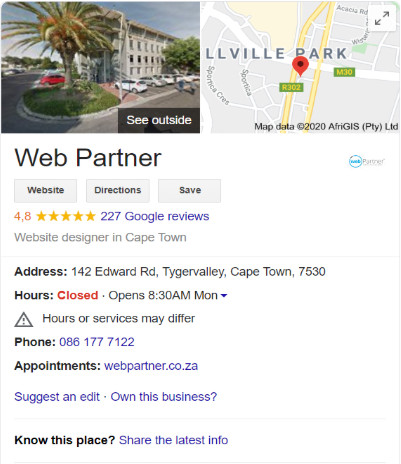
To start the listing process, first you need to create your listing, then the account has to be verified. Once those steps are completed, you can then optimise the account for search, and to better promote it.
Step 1: Creating your account
Google has simplified the process by guiding you through each step.
First, you want to ensure you’re logged into an existing Google account. Once logged in, head on over to https://www.google.com/business/ to start the process.
Find your listing
Once you’re on the Google My Business homepage, you want to establish whether there is an existing listing for your business, this is if you’ve previously created a listing.
When you click on manage, you’ll be redirected to the following page where you can either find your business or start setting up a new listing.
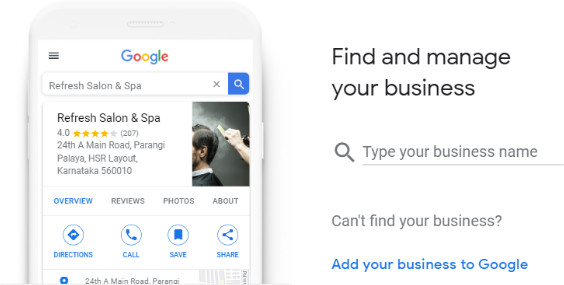
Choose your name and category
If there is an existing account, you can proceed to claim it. If it’s a new account, you’ll proceed to the page that requests your business name, the category that best describes your business.
Add your location
If you have offices or a physical store, you can include this, as it will show on Google Maps or when people are searching for you. Hereafter, you’ll have the option to include additional areas you may serve or deliver to customers (if applicable).
Add your contact details
Include all the necessary contact details that will help customers get in touch with you, all contact details you enter . Here, you can also include your website. And if you do not have one, Google allows you to create a free, basic website (this will not include your official domain registration or emails and hosting).
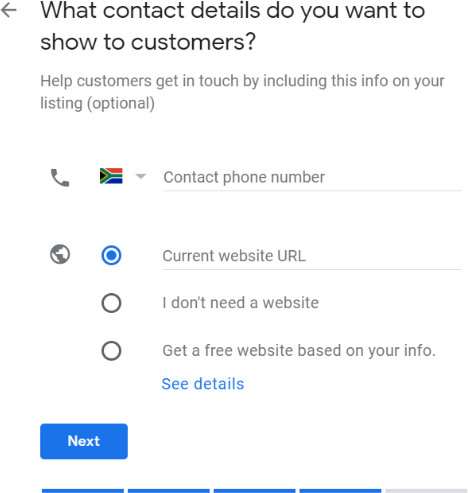
Set up completed
You have now successfully completed step one and can start managing your content within your Google My Business Listing.

Step 2: Account verification
You’ll need to confirm that the business is yours by verifying the account. Google permits account verification in two ways, you can either;
Postcard verification
Have a postcard mailed to the address under which you’ve listed the business. For businesses based in South Africa, this usually takes roughly 21-22 days to arrive via post. The card will look as follows, and you’ll need to follow the steps on the card to proceed with verifying your Business Listing.
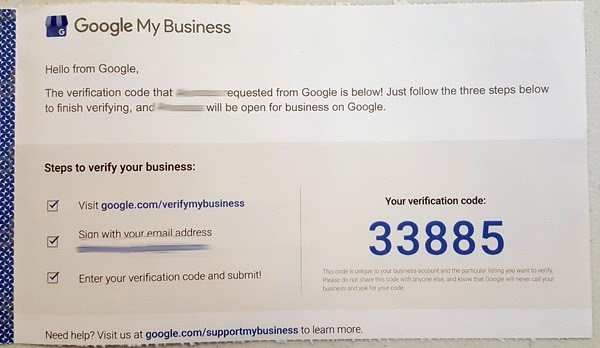
Verification via email or phone
Although this method is the easiest, it’s worth noting that not all businesses are successful in verifying via email or phone. If your business is eligible, you’ll be prompted to either complete this step via email or phone, to which the code will be sent.
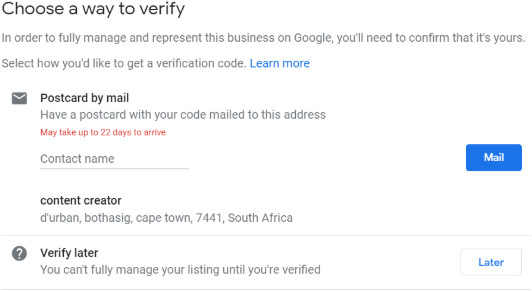
You’ll be taken through a series of additional steps to complete your listing;
Listing your services
Adding your business description
Adding images of your business - this can be products, your offices or images relevant to the service you offer.
Thereafter you’ll be directed to your business listing dashboard where you can start filling in all relevant information to optimise your listing.
Step 3: Optimising your listing
Optimisation is key to getting your customers to find your business. It’s worth mentioning, an optimised listing requires constant and consistent efforts. It’s not about adding a lot of information, it’s about adding the right and most relevant information.
- Focus on content that is most relevant to your customers
- Have images that will appeal to your customers
- Be sure to manage and respond to reviews (both good and bad)
An optimised account includes the following:
- A cover image that is a clear reflection of your company, since it will be displayed at the top of your listing, it needs to be the correct size and resolution.
- Regular posts to keep visitors informed and up to date. Don’t post for the sake of posting, your content should at all times be purpose-driven.
- Responds to customer reviews.
- Allows for direct messaging.
Like any other efforts invested into getting your business seen, a Google My Business listing is an investment that’ll pay off in the long-run. To get started with your listing, head on over to https://www.google.com/business/, or if you need professional assistance, get in touch with us and we’ll help you set up a fully optimised listing.
We’re all familiar with the term “what’s trending”. Every year there’s a
round-up of new trends you can expect to see make waves. Ones that’ll grace us
with their presence a little while longer and others that have outlived their 5
seconds of fame.
Lets take a look at what’s hot and what’s not in the world of
social media:
TikTok
TikTok,
the social platform that has taken centre stage and continues to shine bright
during quarantine. Move over Gen Z, you’ll find a number of Millenials and Gen X
users who can give you a run for your money.
Launched in 2016, this 4-year old platform currently stands at 800 million
users worldwide. Impressive, right?! As a short-form video platform, TikTokkers
can create original content, recreate scenes from movies or music videos and so
much more. Their mission is to inspire creativity and bring joy - both of which
they’ve nailed.
Did you know, of the 800 million users TikTok has, 500 million originate from
India?
Video content
YouTube,
TikTok,
Facebook
and
Instagram lives - need we say more? Video is big, and we’ll continue to see
it increase in popularity for some time to come.
Why is this great for business? For one, you better your chances of reaching
a wider audience. Add in video’s ability to help you better communicate your
message to your current and potential customers, your competition will have the
odds stacked against them.
And while some may say it’s an investment that can cost a fortune, that’s not
entirely true. Although you may need specialised equipment or a professional to
shoot or edit advanced video content. It is highly possible to produce DIY
videos your audience can relate to.
And speaking of relatable content, real and raw (unedited and unscripted)
videos have become a big deal and have a massive impact on audiences.
Communities / Groups
Communities and groups have somewhat been underappreciated. But consider all
the Facebook community and business / networking groups you belong to, you’ll
see there’s more worth in them than we’re willing to give it credit. Groups and
communities have been around for a while. It’s where like-minded individuals
join to share ideas and knowledge.
In 2020 we’re saying YAY to rallying your supporters together in a brand
community to keep them informed and interested.
Instagram likes
If you’re one to count the number of likes your Instagram posts get, brace
yourselves, Instagram has started hiding likes! While this has only been
implemented in Canada, the US and a few other countries, we can most certainly
expect to see it be rolled out in South Africa too. This hot topic has had many
naysayers disapproving of the idea, but here’s what you need to know:
CEO,
Adam Mosseri announced, the reasoning behind making likes private or hiding
them is to make it less about competition and more about connecting and
conversations.
Check out the clip where he explains why likes are being hidden
https://twitter.com/i/status/1192962986224128005
There’s however no reason to freak out. Likes won’t disappear, instead, it
will be hidden to your followers and will only be viewable to you. How will this
impact businesses? There’s no major impact on brands, the only difference is,
brands will now be forced to shift their focus to becoming more creative with
their content and how their audience connects and engages with the content. And
in our opinion, that’s all-in-all a step in a more positive direction for
businesses.
Paid advertising
“If you want to make money, you need to spend money”, so profound and so
true. Social media platforms in South Africa collectively have over 1 million
users on EACH of the major platforms.
That’s a lot of potential business! And with targeting becoming more and more
precise, social media platforms are allowing you to reach more people faster and
more effectively.
Social listening
Many speculated and questioned, is this real? Are brands listening in on
conversations? Yes, but not in the secret agent kind of way. Social listening is
merely a way for brands to suss out what people are saying about a brand /
industry by keeping a watch on online conversations.
If you’re going to sell your product or service to an audience, you need to
have an understanding of who you’re selling to and what they need or want.
When you listen, you learn; and when you learn, you’ll sell better and
faster.
Below are some of the not so hot trends we can see fade out on social media.
Long video ads
Who doesn’t love a good video ad? Video is progressing rapidly, but no one is
truly intrigued by a 3-minute long video ad. If it’s relevant, to the point,
catchy and creative; your ad will appeal to the masses. Ideally, you want your
ad to be between 30-90 seconds long. In doing so, it’s easier for the viewers to
digest, you can easily hook them and they’re far more likely to take action.
We’re not saying longer videos don’t work, but when we consider audience
preferences, shorter ads in present times have far more of an impact and a
higher conversion rate.
Generic visuals
Marketing has evolved to such an extent, it is now perceived as an extension of
your customer service. Brands are digging deep and focusing on connecting with
their audience on a more personal and relatable level. Images play an important
role in this communication and connection, so generic images just won’t cut it
on social media anymore.
Here’s some key points for getting your message
across with visuals on social media:
-
Authenticity is
EVERYTHING - be true to who you are
-
Design with your audience
in mind - what’s intriguing to them?
-
Research what’s hot -
trends exist for a reason
As
marketers, graphic and
web
designers, trend watching is a BIG deal - mostly because it is relative to
the success businesses experience online. And we’re all about putting our best
foot forward for our clients.
An unprecedented event like the Coronavirus will have us question more what
will break us and believe less in what can potentially make us.
In times when uncertainty surrounds us and we’re faced with obstacles that can
severely impact what we’ve achieved and still hope to achieve, we begin
questioning our survival.
To help your business rise to the top during bad times and remain at the top
during good times, there are some fundamentals every business needs to survive.
1. Have a plan
Every business has a foundation on which it is built. All your
decision-making, failures and success will be centred around the plan you have
in place. It helps you decide which decisions to make when, keep track of the
goals you set out to achieve, ensures everyone’s on the same page and prevents
chaos from erupting.
2. Invest in knowledge
Knowledge is power! To grow professionally, we need to continuously invest in
becoming knowledgeable. For teams especially, learning skills such as
communication and teamwork are as important as the professional skills needed to
fulfill their roles within the business. Knowledge will have a direct impact on
the success of your business.
The knowledge and skills we acquire through learning allows us to:
- Achieve more goals
- Have a better understanding of our customers, their needs and how to
properly meet them.
- Build more meaningful relationships with both employees and customers.
3. Be willing to adapt
Stressful situations can completely throw us off course. But just as
adaptation is necessary in our everyday lives and everyday situations, it is
equally important in business, and even more so during a crisis.
Adapting shows resilience to a stressful time and an openness to change. Your
business’ ability to evolve and adapt to change will help you tackle problems
and make room for new and better opportunities.
4. Take risks
Business 101: you need to be willing to take risks! Risks mean choosing to
face the fear of uncertainty, regardless of whether that risk will pay off or
not. When you take risks, you learn valuable lessons that will help you make
better decisions in future.
The benefits of risk-taking:
- It builds confidence
- Helps you step out of your comfort zone
- It can help take your company from good to great
5. Set goals
Your success in business is only as good as the goals you set and the effort
you put into achieving them. Goals play a pivotal role in the long-term vision
of the company. They drive motivation and determine. The more goals you set,
both big and small, the more focus you’ll gain, and the more that helps
determine what you truly want.
In business, challenges and change is inevitable. Your business can thrive one
day and the next you’re dealing with a blow that you didn’t anticipate or plan
for. Your survival in business runs parallel to your survival as a human being.
Have you ever wondered how so many of the brands you follow or admire on
social media manage to have messaging that is on point, images that are visually
appealing and videos that are creatively constructed? They seem to just know how
to appeal to their audience.
The hype around social media and the importance of social media marketing
won’t die down anytime soon. And the need for a social presence is becoming more
and more evident.
But, what exactly is social media marketing and why should business owners
note its importance?
Social media marketing is the use of social platforms (Facebook,
Instagram, Twitter, LinkedIn, TikTok etc) to promote your business and to
connect with an audience.
Through social media marketing and establishing a social presence for your
brand, you can:
1. Create brand awareness
As internet users, we spend a large portion of our time on social media, and
with over 1 million social media users on each social platform in South Africa (Facebook,
Twitter, Instagram and LinkedIn), you want to be where your audience is.
By creating content relevant to your product or service, providing
information about your business and sharing your portfolio; you can increase
your social following and engagement on your social media pages.
2. Make money
For the majority, the goal is to make money from the efforts invested into
social media marketing. But you need to be tactful in your approach to sell,
when you come across as too salesy, you’ll discourage people from taking action.
So, how do you target the people you’re looking to connect with? You can
offer incentives for participation in contests or do launch giveaways. Any
promotional content you put in front of your audience that aims to convert
should be end-game driven, but your audience and their needs and wants still
need to be kept in mind.
3. Keep an eye on the competition
No matter the industry you are in, there will always be another company or an
individual you’re having to compete with. And with more and more service
providers entering the market, this can make it hard for you to compete.
Keeping an eye on your competitors allows you to assess where their strengths
and weaknesses lie, how much of a threat they pose and the opportunities you can
identify to better your product or service.
4. Connect with your audience
Social media is at its core all about connecting. Keep in mind that people
buy from people. Through connection, you can build meaningful relationships and
rally a team of loyal supporters. Make responding to their questions or comments
a habit. Ask for their input and feedback. And make an effort to understand
their interests.
Creating your social media marketing strategy
Your efforts will prove to be fruitless if you don’t have a plan
(strategy) that details what you wish to achieve, when you
wish to achieve it, how you plan to go about achieving it and why
you’re taking certain steps to achieve your goals.
To build your social strategy, you need to:
1. Determine who your audience is
You need to have a well-rounded idea of who you are wanting to target. Who it
is you’re ideally looking to sell to. Think about the needs and wants of these
individuals and how you can or plan to fulfil it.
Your ideal customer can be characterised based on:
Location - where they are situated. Are you looking to target people
based in a particular area or nationwide?
Age - what age group does your ideal customer fall into?
Gender - is your product or service best suited to men or women?
Interests - does your ideal audience have any definitive interests and
buying / spending habits?
Example: I am targeting women in South Africa (nationally) aged between 20-50
who have an interest in makeup and spend on average between R800 - R1 000 per
month on makeup products.
2. Set goals
It’s important that you give careful thought and consideration to what
exactly it is you wish to achieve. For some, the goal might be to increase
sales, while others may wish to grow their following. Whatever your goals are,
keep the S.M.A.R.T principle, as demonstrated below in mind.

3. Determine which platforms you’ll target your audience on
Social media platforms have as many differences as they do similarities. And
although they’re all great in helping brands create awareness, the platform(s)
that best suit your business strongly depends on where your audience spends
their time and the product or service you offer.
Example: you’ll have a better chance of finding professionals on LinkedIn,
while teens and young adults live on Instagram and TikTok.
This is not to say you can’t market your brand on multiple platforms. Your
messaging is what will differ based on the platform and the audience each of
them are intended for.
4. Creating content that’s interesting
The content you create and distribute across the various social media
platforms need to serve a purpose. As a general rule of thumb, your content
needs to:
- Educate / inform people about your product or service and industry.
- Be engaging (funny, interactive like Facebook or Instagram lives)
- Motivate people to take action
- Show that you’re knowledgeable and in the know
- Have relevance
- Show that you care
5. Put a schedule together
Content that is planned and scheduled in advance will save you time, make it
easier for you to track how your content is performing. You will get a better
indication of what’s working and what’s not working for both your brand and your
audience.
Facebook’s scheduling feature makes it easy for you to schedule a number of
posts in advance.
For scheduling of multiple posts across multiple platforms, third-party apps
like ZohoSocial, Buffer, Sprout Social and Hootsuite will help you plan all your
content and provide you with feedback reports and insights.
6. Measure the results
Input = output. It’s important that you measure and track the results of your
efforts, this will give you a good indication of how to plan your social
campaigns and content calendars.
Your goals will determine the metric by which you measure your results.

With so many factors to consider, we understand social media marketing can be
overwhelming. But to ensure you get the best return on investment, it’s
important that your social efforts are done right.
Henry Ford once said, “coming together is a beginning. Keeping together is progress. Working together is success.”
Teamwork in the workplace and the importance thereof often sounds like an overstated subject. Some may even deem it a topic that’s a waste of time. But a company is only as strong and as successful as the crew helping its captain steer the ship in the right direction. And while conflict and challenges are inevitable, when teamwork is encouraged and part of your core values, you leave little room for error and chaos, and can set your business up to operate like a well-oiled machine.
Increases productivity
Pushing to get the most from your team is counter intuitive when you’re not getting the best out of them. Clear communication, encouraging collaborative efforts and setting individual and team goals will help get your team to be both efficient and effective, in a way that lends itself to achieving the long-term goal of the company.
Promotes Unity
People differ vastly; in personalities, beliefs and their work ethic. This can sometimes be a recipe for disaster. But when individuals join forces and work together, instead of against one another, they’re bound to be much stronger.
To promote unity within your team, and to get everyone on the same page, you need to:
Have strong leaders
Make communication a priority
Define and communicate the company goals
Define the role each person plays
Boosts morale
We spend a large portion of our days surrounded by those we work with, so it’s important that a sense of inclusivity and working together, as a team, remains one of your key missions. When the morale boosters outnumber the barriers, you’ll have a disciplined and confident team who’ll be motivated and enthusiastic about the mission you’re working towards.
Here are a few ways in which you can boost your team’s morale:
Pay attention - pay attention to the individual and collective needs of your team.
Social interaction - although it may not be necessary for work employees to form friendships outside of the work environment, it is good for your team to get together outside of work so they don’t feel like an object of labour.
Team meetings - effectiveness won’t be short lived if you make regular meetings a priority.
Check in vs check up - when you check in with your team, as opposed to just checking up on them regularly will make them feel valued and important.
Recognise and reward - help drive your team by recognising their efforts, showing appreciation and giving credit or rewarding hard work where it is due.
Improves learning
Employees are likely to learn better and better develop their skill when they’re working as part of a team and learning from fellow employees. Contributing to your team’s learning and fostering an environment that encourages innovation and creativity will in turn contribute to the success of the company.
Your team is central to the performance of the company, and when a spirit of togetherness is fostered, it pushes teams to perform better and helps your business rise to greater heights.
In today’s world, you’re bound to hear about the importance of digital marketing. While some see the value in it, others deem it an overemphasized topic or a buzzword that carries little to no value.
Often, this comes from not having a good enough understanding of what digital marketing truly is and how essential it is to any business in modern times. As illustrated below, digital marketing is simply using the internet and electronic devices to promote a product or service to a target audience.

So, why does digital marketing matter so much and why should business owners invest in it? A stats report released by statista.com shows there are 22 million internet users in South Africa, and this number is expected to grow even more in the years to come.
- Facebook: 17.6 million users
- LinkedIn: 7.6 million users
- Twitter: 8.3 million users
- Instagram: 3.6 million users
- WhatsApp: 1.5 million users
- YouTube: 1.9 million users
With these numbers in mind and taking into account how much of our day is spent on our phones or in front of our PC’s - either searching the internet, watching videos or browsing and posting on social media, this is where relationships and connections between businesses and their audience is formed. Any business can generate business from at least one, if not all of these platforms.
There’s the assumption that digital marketing is about social media, but social media is not all-encompassing, it is merely one aspect of digital marketing. And before we look at the importance of digital marketing, lets take a deeper look into the types of digital marketing your business can benefit from.
Google Advertising
People all over use Google to search for products, services or ideas. With Google ads, you too can be found on Google and drive relevant and quality traffic to your website that can convert into leads and sales. Coined the platform that offers the best ROI and the fastest results, Google advertising can help put your business on the map.
Search Engine Optimization
A site that ranks well in search engines will have website traffic streaming in. And although the focus is more organic and requires ongoing work, once you identify the keyword and phrases your target audience uses, you can get good results from having a website that has been optimized for search.
Social Media Marketing
Social media has become an essential part of our daily lives and our existence. For engagement and brand awareness, social media platforms like Facebook, Instagram and Twitter are great to engage and interact with your clients. With a bullet-proof social strategy, you can take your business to greater heights.
Video Marketing
The use of video as a marketing tactic has skyrocketed the last few years, and video will keep making waves. From explainer videos, to introductory and funny videos - all of which aims to increase engagement and awareness.
Content Marketing
Content, in all its forms drives to get customers to take action. This can be done through a targeted video campaign, content you distribute on social channels as well as the content that may live on your website that your audience will find useful.
Email Marketing
Considerably one of the most effective and easiest ways to reach your target audience, email marketing allows you to speak directly to them, get customer insight and feedback and build long-term relationships. The key to a successful e-mail marketing campaign is not to spam or oversell. You need to make your customers feel valued.
HERE’S WHY YOU SHOULD INVEST IN DIGITAL MARKETING:
- It’s cost-effective - contrary to popular belief, you don’t need a huge advertising budget for digital marketing. Provided it is done right, and by professionals who are skillful and knowledgeable, you can save a ton of money.
- There’s a good return on investment - the output will outweigh the input when you properly invest in digital marketing for your business.
- It can easily be measured and adjusted - the results can be measured and adjusted as needed. You’ll go through some trial and error to find out what exactly works best for both you and your audience.
- It’s targeted - you can reach your audience precisely where they’re investing their time and money.
- Perfect for creating brand awareness - when you share useful, relevant and engaging content with your clients, you can reach new people and gain loyal followers and supporters.
The key to digital success is ensuring you have a strategy in place that aligns with your goals, that proper planning has been invested into it and that it’s executed properly.
If you’re looking for some experts who are knowledgeable and skilled, get in touch with us.
We live in a world that is as visual focused as it is tech-driven and with 2020 marking a new decade, design trends are expected to peak even higher than before.
The evolution of design has made designers an integral part of the world we live in. With their craft and creativity revolutionising all visual elements that forms part of our daily lives, designers have continued to hype us up. If the predicted 7 Graphic Design Trends in 2020 is anything to go by, we look forward to what’s to come in the years to come.
Monochrome
For some, the use of a single colour may seem boring. But this minimalistic trend has been on the rise in both graphic and web design. Its simplicity helps place emphasis on elements we wish to have stand out. If you’re aiming for a neat and professional look, a monochromatic colour scheme will achieve just that.
A touch of vintage
Being able to draw inspiration from an era where the tools designers have at their disposal today didn’t exist, makes us respect the design gods from the 50’s and 60’s. The 21st century differs vastly from the vintage era. These legends handed modern day designers the design baton, and we can expect to see elements of vintage to shine in 2020 to carry on the classic and timeless legacy.
Artistic typography
When lettering is combined with elements of art, it shows next level, innovative creativity. While plain text can be impactful, using both 2 and 3-dimensional shapes with it can better captivate an audiences’ attention in 2020.
3D
Dimension in design brings a visual to life. Realistic effects in visuals have been making waves and continue to be a growing trend. We foresee designers pushing more boundaries with 3D in 2020.
Masking
Letter and image masking is achieved by applying a layering effect to images or text. This design technique gives an image a modern look and feel and makes specific features of the design pop. Although a trend we will see throughout graphics in 2020, masking has been used in web design too.
Metallics
Not too long ago metals like gold, silver and rose gold became a craze in all things design. It’s sophisticated, elegant and classy effect it gives off makes your brand all the more attractive.
Incorporating metals and using it in conjunction with a variation of branding techniques, like embossing will make your brand look luxurious.
Bolder and brighter colours
Go bold or go home, not entirely how the saying goes but if you’re not prepared to experiment, your brand will fail to stand out from the crowd. Bright and bold colours pop, attracts attention, represents fun and makes you relatable. The advantage graphic designers have is grounds to be as experimental with big, bold and bright colours.
These graphic design trends in 2020 will become the benchmark for all foreseeable designs. Using these elements in isolation or combining them in both your website design or visuals will make your brand stand out in 2020.
Imagine a world without Google - the online library we turn to when we’re in search of products or services, ideas and inspiration and recipes or motivation. Home to billions of resources, Google has greatly impacted our professional and personal lives for years and will continue to do so for years to come.
As big of a resource as Google may be, some may question whether Google advertising is worth the investment for businesses. Like anything, it’s a balancing act - Google will have as many naysayers as those defending its honour. With digital transformation taking place all around us, some are failing to keep up or get with the times. The effect on their business? Losing out on the value and potential Google has to offer.
That brings us back to the question, are Google ads truly worth the investment? When done correctly, YES! And here is why it’s considered one of the best lead generation tools:
Offers the best ROI
First and foremost, the value and success rate of Google advertising for most businesses, compared to social media, other search engines and offline marketing is far greater.
To support this statement, we’ll get stuck into more detail down below.
It’s CONTROLLABLE
You have complete control over your ads and can start, pause or stop them at any time. This means you won’t unnecessarily eat away your ad spend. Lets say you’re going on holiday and won’t have the time to monitor your ads or wish to not run it for the period you’re away - you can pause whichever your campaigns and start them again at a time that is convenient to you.
Budget allocation is entirely within your control, you’re free to spend as much or as little as you want on your ads for the day. This means if your search volumes are higher weekdays and there is not as much traffic weekends, you can allocate a lower budget to your weekend spend. And if Google ads are new to you or you have limited funds available, you can start small and increase your spend as need be.
Additionally, you can decide what position you wish to rank in Google and whether you wish to advertise only on Google or both Google and Google search partners, which are Google approved websites such as Gumtree and OLX.
You can be SPECIFIC
With Google being a targeted search engine, you can specify;
The exact area you wish to search, what searches you want Google to include or exclude,
You can target by your preferred demographic; the two main segmented groups being age and gender.
If you’re looking for a targeted platform that’s geared toward displaying the most relevant search results and offers high-quality leads, Google is the perfect place to advertise your business.
In saying this, and to properly benefit from the results Google has to offer, you need to understand:
1. Although Google is great for many service-based offerings, there are some niches that won’t work as well on Google. For more on this, find out if you’ll best on Google or Facebook here.
2. You need to have a website that is optimized with the correct landing pages and more importantly, your Google account has to be set up properly.
If you’re in need of expert advice or need a Google specialist to assist you, get in touch with us.
Facebook and Google, two platforms that have respectively earned the trust and support of many and have positioned themselves as advertising space that helps bring in the buck for many businesses.
With both platforms receiving large volumes of traffic and both generating leads for businesses through pay per click ads, one can understand why many would wonder which is best for their business.
To determine which is better, you have to delve deep and conduct proper and extensive research. You need to give consideration to the nature of your business, your goals; both short and long-term, what’s your budget, your competitors - these are all determining factors factor when weighing up which platform is best suited for your business.
Before we get into the above factors, lets first look at what each platform is and isn’t.
Facebook
Best known for its social benefits, Facebook is a great community-driven platform that is perfect for creating brand awareness and engaging with your audience. Between the two, it is also a more affordable advertising platform.
Google
A more targeted, keyword-driven platform that offers fast and immediate results. Your ads are guaranteed to only display people type in specific search terms and you only pay when they click on your ad.
With the above in mind, lets take a closer look at those determining factors:
Nature of your business - the product or service you offer largely determines which platform will yield a better return on investment when we’re looking at Facebook vs Google ads. Google works best for service-focused businesses (not all), including the likes of construction, plumbing and paving contractors. While Facebook, on the other hand, is an ideal “marketplace” for most products and services that aren’t search-driven.
The bigger benefit in Facebook is its ability to help create brand awareness, and together, they work great for any business.
Goals - consider your short and long-term goals; if you’re looking to get immediate results and quality leads that have a higher conversion rate - Google would be your go-to platform. If the goal is to build your brand into an authority position and create a brand presence, Facebook will work best.
Budget - many times people make the mistake of budgeting incorrectly or allocating ad spend to the wrong platform. If you have a budget of R500 and your business is best suited for Google, and your goal is to get leads that convert; your best bet is to allocate that R500 towards Google ads. While the “audience reach” on Facebook may be enticing, Google is more targeted and can give you a better return on investment for your R500. Where your budget permits, you can do a split between Google and Facebook advertising, this way you can get high converting leads and build your credibility as a brand on social media.
Competition - competitor analysis is crucial. You need to look at who and where your competitors are targeting people. This allows you to compare and better your own marketing efforts.
The major difference between Facebook and Google ads is one is a paid social platform, while the other is a paid search platform When these factors are taken into account, that is largely determined by who you’re targeting, your budget and the overall goal you’re hoping to achieve.
Social media engagement is just another term for interaction that aims to build relationships and awareness. Its purpose is less about promotion and more about connecting an audience to a particular brand.
Many times the focus for businesses becomes the product or service they offer and how to promote it to increase sales. And although the ultimate goal for many businesses is to generate more income, people often find constant sales pitching overbearing, which discourages them from taking action and puts a divide between the audience and the brand.
The focus and efforts should, therefore, be invested in connecting with your audience, rather than selling, as the connection will have a direct impact on growth and how these connections can convert into clients.
In 2018 Facebook released a video explaining that they will prioritise personal posts over brand focused posts. This caused quite the frenzy and businesses started experiencing a sudden decline in their audience reach which in turn made it difficult for them to promote their brand.
The misconception of social engagement was evident, and there seemed to be a lack of understanding of how to build connections and content that would encourage meaningful interaction.
To properly connect with your audience, you need to understand what they need and when they need it as well as what they want and expect. More importantly, your connection with your audience will be deeply rooted in the authentic brand voice they are able to identify you by.
Take Nando’s for instance, they take controversial subjects and put a humorous twist to it. It’s what they are known for, and it is how they connect with their audience and drive social engagement. What’s the unique brand voice that is helping you drive social engagement? If you’re unsure of how to identify or build your brand voice, connect with us and let us help you be uniquely you.
Content aside, social media engagement is about more than just what your audience can or will find interesting. Many have started turning to social media to seek feedback from brands, making social platforms a line of customer care too. And as a business owner, you’ll find it to be as much of a learning hub for you as it will be for your audience.
Through social media, businesses can connect with their audience and establish and better understand customer needs through live chats and Q&A’s.
To better understand social media engagement and to implement the correct processes to improve social engagement, you need to overcome the overuse of promotional posts and connect and interact with your audience the same way in which you would with brands you connect with.
With so many different social networking platforms that allows you to connect with people, nothing connects professionals from across the globe quite like LinkedIn.
Of its 675 million global users, 7 million are from South Africa. Professional networking is a good way to develop professional relationships that can help boost your career or grow your business.
So, how exactly can you use LinkedIn to your advantage? Check out our 5 top tips that’ll help you better your networking skills on LinkedIn.
Have a complete profile
You want to ensure you make a good and lasting impression when people land on your profile.
- A good quality, professional profile picture is important.
- Provide a detailed overview of who you are and what you do in the summary section.
- You can use the cover image space to highlight your profession or something that fits your personality.
- Make sure you provide as much detail about your work history as possible. And list the current position you hold.
- Include all formal qualifications and certificates you may have received.
Post often
You need to make an effort to have consistent activity on your profile. But unlike Facebook, your content should be engaging and relevant to your industry in order for you to build better connections.
Add your link to your social profiles
Adding your LinkedIn profile link to other social profiles like Facebook, Twitter and Instagram drives connections to your profile and helps increase your professional network. You can also include it in your e-mail signature and your resume.
Send thank you messages
Not only is it courteous to send a thank you message when people have sent you an invite to connect or when they accept yours, but it also acts as a great conversation starter with a professional you’re looking to engage with.
Recommendations / Endorsements
Recommendations and endorsements are testimonials of your skills and emphasizes your professional capabilities. You can ask former or current employers or people you have worked with to endorse a particular skill set or for a recommendation. And you can do the same for others.
Don’t be afraid to connect and engage with people within your industry. Professional networking is an ideal way for you to build meaningful relationships and connections with other professionals. It can present many opportunities for you as a professional and for your business.
The worldwide effect of the Covid-19 pandemic has been devastating. With over 1 000 confirmed positive cases to date, the impact on our people and the rapid spreading of the virus has forced the government to take drastic measures to flatten the curve.
With the country on a 21-day lockdown period, the outbreak of the Coronavirus has had a crippling effect on small businesses and the economy as a whole.
Small businesses were first in line to bear the brunt. The sudden and hard hit forced many businesses into fight-or-flight mode. While some were faced with the harsh reality of permanently having to close their doors, others are preparing for the road to recovery.
It’s a scary time for small businesses. They’re faced with many concerns - how they’ll survive the aftermath, the financial pressure and lack of income to sustain themselves. Some have salaries, rent and overheads to pay. And with so much uncertainty, the next steps are unclear.
For all small business owners overcome with worry and concern:
Be proactive
Your business cannot afford you to become complacent. Now might be the perfect time to invest time and energy into the aspects of the business you may have neglected or struggled to get to previously.
Take time to reflect
If you think back to where you started and where you’re wanting to be, which areas of the business work and which doesn’t work? How can you rectify the wrong and better the right? Take time to reflect to determine what can be done to keep your business moving forward.
Be prepared
No one saw the outbreak of a virus coming and we didn’t quite prepare for the impact it was going to have. With the numbers growing, be prepared for the likelihood of it getting worse before it will get better.
Communication is crucial
Whether you’re a team or a one-man show, clear communication is absolutely necessary right now. Find the right processes and tools that’ll work best for you and your team to effectively communicate with one another, clients or suppliers.
Be a positive support
Now more than ever, support is crucial. The people serving our country during this time of crisis need the support of the nation. You as business owner, your staff and fellow business owners need support and positive reinforcement. Use this as an opportunity to be a motivation.
Surviving the Covid-19 effect and rising above the ashes is possible, we believe all hope should not be lost and we should all stand together in support of businesses affected.
Does growing your business into a million dollar company seem far-fetched? If so, change your thinking, own your goals and adopt the mindset of a millionaire!
Lets be real, the rags to riches narrative makes the road to success seem easy. But it’s not! There are obstacles and challenges along the way.
Even billionaires like Bill Gates and Richard Branson failed and fell. But they got back up and their dreams worked because they did.
The premise of a million dollar mindset is smart thinking and smart decision-making, and when put into practice, these two principles can transform your business.
Below are some key steps in developing a million dollar mindset:
Keep learning - our learning days are never over, especially not in business. We live in a world filled with millions of resources that allows us to further our knowledge. Think of all the books, videos, articles and podcasts we have access to. When we learn more, we better both our understanding of things and our skills.
Adapt - business will always require us to adapt, whether it’s our thinking or our approaches. Changes in technology, a fluctuating economy, an increase in competition - these are all contributing factors that’ll force us to adapt in business.
Take risks - risks are a double-edged sword, the fear of what could go wrong overshadows the possibility of what could go right. You need to be willing to take risks, regardless of whether it will have a good or a bad impact on your business.
Focus on your goals - setting goals and working on ways to achieve them is important. You need to consider what your short and long-term goals will be. And keep in mind that hurdles along the way will take you off course, but the more you stand firm in what you wish to achieve and the more you place your focus on those goals, you better your chances of achieving them.
Invest wisely - the true value of money is seen in how you choose to invest it. Forget recklessly spending your money on material things that carry little to no long-term value. Consider options like property or shares. Skill and talent is also an investment that can benefit your business.
In business; the pressures, doubts and fear of failure can be a major setback but you need to confidently take charge of your thinking and believe in the value you as an entrepreneur bring.
👍 We share this information,
so that you do not make the same mistakes we have.
It's extremely important that you understand
a Website is not going to promote your business.
WTF are you talking about Brian?
If you think that spending money on a website, will give you a return on investment,
Then STOP Now, because IT WILL NOT!
OK, so you get a website for your business
It looks stunning, smart and really awesome.
Now what?
Who is going to see your website?
Nobody is going to see it.
You going to send it to friends and family?
You will add it to your business card or a brochure?
So who do you Really want to see it?
Potential clients, that's who - Clients that are searching for your product or
service online.
So how will they find your website?
DIGITAL MARKETING
I go to Google and I search for your service or product and I find your website.
I'm on Facebook and I see your business in my feed.
I'm watching a video on youtube relevant to your product/service and ahaa, here
I see your business.
That is how you promote your business.
A website alone will not do this.
Your website becomes the destination for potential clients to find your business
on all the various platforms.
Some of your clients are on Facebook, some LOVE Instagram.
You have to present your business on those platforms and drive those clients to
your website.
Ok, so the client found your website.
Website looks awesome, you listed all your products and services, but still they don't phone you. Why?
- Because your website is boring
- you are not connecting with your customer
- you have a poor user experience
You must have high converting landing pages with content the user find
interesting and they want more information.
You must have CTAs - Call to Actions
You cant just show your visitors who you are and what you offer.
You must ask them to take action eg.
Fill in the form and a consultant will contact you
Complete your details below for more information
Click here to contact us now
You have to tell them what to do.
I can guarantee you that any startup business can be
successful from day 1.
If its not, its because your digital marketing is crap.
AND forget about doing everything yourself
(every successful business owner will tell you - employ professionals for
everything)
Yes Brian, but experts are expensive - Nonsense!
You can get access to Experts that will not break the bank.
If you really want to boost your business immediately, speak to an Expert now
As the largest and fastest growing networking platform with a primary focus on professional networking, LinkedIn has made it their mission to help small businesses grow effectively. LinkedIn Open for Business, a product specifically designed with small businesses in mind, helps make you discoverable and easily connects you with potential clients and fellow professionals.
Like many other social networks, there are several ways in which LinkedIn can benefit your business and help it grow.
Brand Awareness
By now, creating a name for yourself is a no-brainer. Social media has become the perfect tool to help create awareness, get your message across and to educate your potential audience on the product or service you offer. The rewards you can reap from LinkedIn are endless and can help position your brand as an industry leader.
The key to effective marketing on LinkedIn is ensuring your profile is optimized. You need to provide as much detail as possible. It is important to complete all relevant fields; including your About Us, clearly displaying your logo, contact details, location as well as your company size on your page. The more insight you provide, the more people you’re able to reach.
Business Connections
A gold mine for networking with professionals globally, LinkedIn is not only ideal in building meaningful relationships with fellow business owners and/or service providers both locally and internationally, but making connections in business can also help increase your sales.
Attract more clients
For most businesses, the primary objective is to generate income. While social platforms function as a means to connect and engage with your audience, the end goal is to have these connections and engagement translate into sales.
Getting your brand name out there on social networks like LinkedIn will better your chances of attracting and converting the right clients.
Find skilled staff
Sifting through dozens of resumes and conducting interview upon interview to find the right people who possesses the necessary skills can be a tedious process. With LinkedIn, you’re able to narrow down your selection, saving you time and money. The added benefit is that a platform like LinkedIn can also help attract potential candidates, and instead of you having to find them, they can find you.
Positions you as credible
Credibility in the digital age is crucial. Competition is everywhere and you need to stand out above the rest. Having a social presence can help you build trust with your audience. LinkedIn also allows you to show off your accomplishments and achievements, which further contributes to your brand’s credibility.
As a professional networking platform, LinkedIn can help make your business a success!
While there are elements within a website that are constantly changing, there are some basic components that have consistently set a good website apart from a bad one. When people think good vs bad design, they consider the look and feel of a website. And although a valid point to consider, the elements that make up a good website goes beyond its appearance.
When people visit a website, they expect the browsing experience to be as effortless as possible.
Good Elements:
Responsive
Mobile FIRST! We can’t emphasize this enough, a responsive website is non-negotiable. Since majority of your website visitors will likely view your site on their mobile device, you need to ensure your website adapts to different screen sizes. This means your focus needs to be placed on the content. With the website’s objective in mind, display all content according to that which will take priority.
Clear call to action
One of the main goals of a website is to get visitors to take action, this means your call to actions have to be strategically and clearly featured throughout your website. Any good website will have a call to action in both the first and last sections. Without a clear call to action, your visitors won’t know which steps to take next. If the aim is to have them fill out a form, sign up for a newsletter or purchase a product, your instructions have to be as clear and as understandable as possible.
Text to image ratio
Text heavy sites are as bad for business as websites that are laden with images. A good balance between text and imagery makes it easy for visitors to browse your website, find the information they are looking for and to take the necessary action.
Bad Elements:
Poor navigation
Navigation bars and menus are the defining element that’ll either make a website useful or useless to your visitors. Like call to actions, these need to be strategically and carefully displayed. Bad navigation will result in members not knowing what to do next and this will make browsing unfriendly to your visitors.
Lack of contrast
A lack of or low contrast website is dull and boring. Having contrast between all the elements adds prominence and character to your site. To get a well-balanced website; consider variations of big and small elements, texture, the colours you’re using or different imagery styles.
Mismatched colours
Your brand colours are crucial to your business, and it’s important to consistently use your colours throughout your branding, on your website as well as your social media. If your brand colour scheme is made up of a selection of colours, it may not be necessary to use all your colours throughout your website. Using colours that will complement one another will make your site attractive to visitors.
With so many elements to consider and the barriers they pose to helping you achieve your website’s objective, it’s important that you design with your user in mind.
Facebook – the social network that is not only the largest, but the most used
worldwide. What started out as a simple networking platform in 2004, has since
grown into an empire that dominates the online space, thanks to CEO and Founder,
Mark Zuckerberg and his associates.
While the world went through the Facebook craze phase, businesses initially
got little to no benefit from this platform that was launched with the initial
intention to connect people around the world.
Fast-forward to 2020, and Facebook now has features and functions that allows
you to track and analyze data, set up campaigns and get insights that helps you
better understand your potential customers.
Now positioning themselves and gaining recognition as a platform that not
only connects people with people, but also businesses with businesses and
businesses with potential customers.
Facebook, and social media in general has revolutionized the way in which we
think about marketing and how we go about it. More so, compared to other means
of advertising, it is said to be the cheapest form of marketing. This allows
businesses with big and small advertising budgets to benefit from what Facebook
has to offer.
Why is Facebook good for business, you ask? It CONNECTS and CONVERTS. If we
consider the marketing funnel, which in layman’s terms is simply the customer
journey from when they connect with or learn about your brand to when they
convert into an actual, paying client.
1. Awareness
When meeting people for the first time, we make a point of introducing
ourselves. When potential customers are initially introduced to your brand,
before connecting with them, the idea is to create awareness. The more people
become aware of your brand, the better they will connect with you.
2. Engagement
Once you’ve crossed the awareness hurdle, you want to ensure that you
consistently engage with your audience and them with you. When you post
something that resonates with them you’ll get likes, shares and comments.
3. Conversion and Loyalty
The purpose of awareness and engagement is to drive conversion and retain
loyalty. Once a potential client becomes an actual sale, you want to ensure they
continue choosing your brand or recommend you to others in search of your
product or service.
When we take this funnel into account, in conjunction with the amount of
active Facebook users who is or can be potential clients and things like
Messenger and Marketplace that seems to be a hotspot to buy, sell and advertise;
there is endless potential for your business on Facebook.
If you’re running a business; big or small, reality is, regardless of how
hard you try, it just won’t be possible for you to satisfy each and every
client. While good service and great feedback may be what you ultimately aim
for, you have to take the bad with the good.
Reviews have become a common way in which customers either express their
appreciation for good service or a means to complain and notify society of how
terrible your product or service was. Lets be honest, reading words such as
“horrible”, “worst” “unsatisfactory” or “I wouldn’t recommend them” is not
particularly how you wish to be perceived by potential clients. There’s two
sides to every coin, while it may be possible that you’re at fault, and despite
society conditioning us to believe that the customer is never wrong, there is a
big possibility that the customer may very well be wrong.
Getting reviewed can be scary and there’s a REAL fear of how damaging it can
be to your business’ reputation. Thanks to a multitude of platforms like Google,
Facebook and Hellopeter, the fate of the feedback you receive is left in the
hands of those who choose to review your product or service.
As South Africa’s leading Design Company, we have the highest amount of
reviews on Google, 224 reviews to be exact. Your customers matter, and so does
their feedback. While good reviews counts in your business’ favour, it is easier
to get a bad review than it is to get a good one. Having said that, the fear of
negative feedback should not be a crutch holding you back from getting insight
from clients. You should be ASKING FOR REVIEWS, and here’s why:
Honesty and transparency can help you improve
Getting honest input from your clients can help you identify potential problems
and find possible solutions that will help better your product and service
offering. This will benefit your business in the long-run.
Shows you’re open to criticism
No one likes to be criticized, and criticism in business is a particularly hard
pill to swallow as people aren’t aware of all the behind the scenes work you and
your team put into your product or service. When you show that you welcome
feedback, both good and bad, it helps strengthen your brand.
It's good for your SEO
While Google takes many factors into account when it comes to rankings, reviews
will help contribute to and boost your positioning in search engines.
Adds to your credibility
People tend to seek out feedback before they make use of a product or service.
If your business doesn’t have any reviews for you to be judged by, potential
clients will more than likely seek assist elsewhere. This in itself, has proven
to show just how much reviews matter and how it can help your brand.
It will increase sales
Sales and credibility goes hand in hand. People will buy from businesses who are
credible and part of their buying decision lies in what the feedback has been
from those who have used your product or service.
In saying that, soliciting reviews the wrong way will have a negative impact on
your brand, and ultimately your sales. Having friends and family members review
your product or service online is a tactic that has little to no benefit to your
business.
When asking for reviews, it is important to help your clients understand WHY you
are requesting a review. Clearly outlining that you’re potentially looking to
better your product or service offering will aid in getting honest feedback.
Advantages of Paying Monthly
- Domain Registration/Renewal Inclusive
- Hosting Inclusive
- Updates/Maintenance Inclusive
- E-mails Inclusive
- Support Inclusive
By now, the known value in having a website for your business is a no-brainer.

With options that includes a ridiculously expensive once-off fee and a fixed-term
contract, your enthusiasm for having a website has probably depleted by now.
We get it; whether you’re just starting out or you’ve been in business for a
while, there’s a constant hustle to bring in business. You have to take an
unpredictable and unstable economy into account, no two months will bring in the
same amount of business for you and with additional expenses to cover, paying a
large once-off fee or investing in a fixed contract can be risky.
Not to worry, there’s a third alternative that has a little light at the end
of the tunnel for you and your business. Monthly web design packages – what’s
the big deal and why should you pay for a monthly web design package? It’s bang
for your buck!
Unlike once-off fees that can be in the 1 000’s, the monthly design option is a
smaller investment that is both affordable and cost-effective.
A website is not a once-off task!
Like most things, it requires consistent
care. Be it in the form of ensuring it’s running safely and securely or
maintaining it on a monthly basis. Did you know, most times once-off packages do
NOT include the maintenance and/or updates and changes your site will require?
That’s right, these extra costs usually come at an additional hourly or once-off
fee.
If you have a website that requires constant maintenance and upkeep or
updates and you’re not tech savvy or capable of implementing these changes
yourself, the long-term cost will add up substantially. We reckon those additional
extras you’ll be paying for can be better invested in marketing and growing your
business.
There’s more to a website than just the design, you have to factor in:
- Domain registration
- Hosting
- Maintenance
- E-mail setup and support

With our monthly web design packages, we offer all of the above as well as a
design that is modern, functional, purpose-driven and trendy and will help get
your business on the map.
If you’re looking to compete in the market, you HAVE TO have an online
presence, and more importantly, a website. Perhaps 10 years ago its relevance
didn’t hold up, but websites have since become the backbone of many businesses,
both big and small. Think of it as your digital home – a place where you get to
invite guests over to introduce them to your brand and the product or service
you offer.
Your customers are adapting to the digital age and all it has to offer, and so
should you. Below we outline 10 Reasons Why It Is Important to Have a Website.
1. Tells people who you are and what you do

A website is no different to an interview. It’s the space where you’re able to
introduce yourself to potential clients, provide insight into the product or
service you offer, how you are able to help them and your background story. It’s
also the place where people can connect with your brand and decide whether
you’re the “ideal candidate” for the job.
2. 24/7 access
Unlike a physical store or an office that has set hours during which they trade,
your website is open for business 24/7. This allows your customers access to
view your website, submit queries or make purchases as and when needed.
3. Builds credibility
If you want to position yourself as a reputable company who people can trust and
want to do business with, then your first impression needs to be a lasting one.
Being credible will easily convince potential clients to buy from you.
4. Keeps customers informed
If there’s constant change taking place within your business – new products
you’re launching, promotions or specials you’re offering or company related
updates you need to inform clients of, your website will help keep people in the
loop.
5. Helps generate business

Did you know, South Africa has over 31.18 million active internet users? If the
goal is to grow your business and generate more income, the opportunity to
attract big business awaits you online.
6. Your competitors have one
Is staying ahead of the competition a priority to you? We reckon it should be!
Your competitors play an important role in the overall success of your business.
Your digital footprint contributes to the way in which you appeal to the target
audience you’re vying for.
7. Allows you to target a wider audience
A bigger audience = potential to make more money. How many potential clients are
within a 5km radius, and how are you reaching them? Think of a website as
virtual expansion, you can reach more people locally and you can take your
product or service to a national or global pool of potential clients.
8. Important for marketing

If you want potential clients to convert to actual clients, having a website
where they will get directed to is important, your website is essentially the
core of your overall marketing strategy.
9. Showcases your portfolio / testimonials
Your portfolio allows people to see what you have done and what you’re capable
of doing. It is usually one of the very first things a potential client will
request from you. If you’ve had good feedback about your product or service,
testimonials will help close the deal on new sales.
10. Cost-effective

The cost of brochures, flyers and other means of advertising to promote your
business can become expensive. A web presence is an inexpensive alternative that
proves to be a constant form of advertising for your business, and an investment
that will save you both time and money in the long-run.
Thanks to technology, you no longer have to rely on door-to-door efforts to reach your target audience. A web and social presence has become a BIG DEAL and business owners are no longer asking how a website or social media will benefit their business, instead, they are asking how to go about getting their business online.
If your business is not yet online and you’re looking to reap the rewards from the many benefits the online space offers, we’ve compiled a list of the 7 magic things to consider when building websites. This 7-step strategy will help keep your business relevant and on track.
1. Plan and invest time

Consider a house for a second, before adding all the bells and whistles that’ll make it aesthetically appealing, the architect has to carry out the planning process and the construction team needs to lay the foundation and work on the structure. The differentiating factor between a successful and a dismal website is the amount of time you invest in it.
When proper planning and time is invested, you increase your pool of potential clients. Think of time as a three-fold factor; your website allows you the opportunity to advertise, advertising results in brand awareness and brand awareness leads to sales.
2. Creativity is crucial

If your website is 10 years old and lacks personality and character, it may be time to ditch the dusty design and wow your audience with a fresh, modern look that’ll help elevate your brand status. With access to a worldwide search of epic designs, you’re spoilt for choice. Research trends and styles that best represents your brand. DON’T copy your competitors or opt for a style that doesn’t suit who you are and what you do.
3. Purpose-driven and audience-specific
A home is designed with enough room to cater to the entire family and with careful consideration for their individual needs. To make it a win-win for both you and your customers, consider how you can best accommodate them and align your design with their needs in mind.
Before you start designing your website, ask yourself what purpose it will serve and who your target audience will be. Make a list of what you wish to achieve through your website and what message you’re wanting to convey to your audience. Be sure to design your website with a goal in mind.
4. Consider the competition

While your competitors may pose a threat, they also serve a valid purpose. They teach you how to set yourself apart and dominate your industry. What’s their unique selling point? Are they offering discounts and specials or free delivery? Are they producing killer content that resonates with their audience? Evaluate their strengths and weaknesses and identify how they are fulfilling the needs of consumers.
5. Mobile-friendly

When people visit your home for the first time and Google maps fails to pinpoint your location, you’re likely to direct them by pointing out buildings or signs they can easily identify with. Your website is no different, with most of your website traffic coming from mobile users, navigation should be as effortless as possible.
If your site is not designed with mobile users in mind, you’re likely to lose visitors. Looking to attract a wider audience, rank higher in search engines and outshine the competition?  Make sure your content (text, images and videos) flows and loads as well on a mobile device as it would on desktop.
6. Maintenance

Technology is not indestructible, problems and website upkeep is inevitable. Do you possess the technical skills and knowledge to fix problems when they arise? If you’re not tech savvy, the help of an experienced designer or developer may be necessary. While some designers may charge once-off maintenance fees, investing in a monthly retainer can save you both time and money.
7. Cost
We tend to consider the cost of anything we need or want. Often asking ourselves if it’ll be a worthy purchase or whether it fits within our budget. Let’s be honest, some things are truly worth a good amount of money. Your website is one of them. Cost essentially depends on a few elements – is it a straightforward 1 or 3-pager, or do you need a fully-fledged e-commerce site that requires some technical skills?
Will it be a DIY website or do you need the help of an experienced web designer? Who’ll do the domain registration and monthly website hosting? For your convenience, we’re your all-inclusive Web Partner offering premium and professional design packages at remarkably affordable prices. 
To ensure your website yields an effective ROI; you need to be flexible to change, willing to adapt and open to growth.
Website design prices in South Africa can range anywhere between R500 to R50 000. Ultimately, the price of a website largely depends on two factors – what you need and who you’re getting it from.
With web design in South Africa skyrocketing in the last 10 years, the demand for websites; both professional and personal has increased. You have the self-proclaimed web designer vying against the seasoned professional and agencies at different prices. A designer worth his money knows what good design entails. The amateur who lacks the necessary skill and experience, and offers template-based designs may not deliver on or guarantee the quality and functionality that a website requires.
For the naïve business owner, the “cheaper” once-off price tag can be enticing and a step in the wrong direction. Asking what the cost of a website should be is kind of like asking what your restaurant bill will come to before you’ve had a look at the menu. There are a number of elements that will contribute to the final cost of a website – you need to take into account your EXACT requirements.
Consider what you do
Are you offering a product or a service? If your website is product-oriented, will you require a shopping cart or e-commerce functionalities? Consider what it is you do; do you offer a product or a service?
Number of pages
Will it be a simple, straightforward one-pager or will there be product categories or services that requires an unlimited number of pages?
Hosting and Maintenance
In order for your website to remain live, the monthly hosting cost as well as domain registration is a must. Often, this, along with the maintenance a website requires gets overlooked. In addition to the design fee, you need to keep in mind the extra costs that will make up the final cost of a website.
While these are only a few elements to consider, we recommend business owners discuss every detail with the designer in advance. It is important to know what you’re getting for the price you’re quoted.
For an affordable solution that doesn’t compromise on quality, get in touch with our team to find out more about our web design pricing options.
The cost these days to simply design a website might shoot through the roof,
or there might be a company that offers you a web design at a reasonable price.
A company, like ours, we offer a monthly service where the maintenance to your
website is free for an hour each and ever month, after that, we start the
billing.
So, where do we start when we are looking for the exact cost to design and
maintain a website? Break it down, start at the cost of the website design, your
platform, your requirements, the layout and from there, depending on the service
you provide or the product you want to sell, the maintenance cost can be
discussed.
Unfortunately websites do not maintain themselves, the best web design strategy
is to change and update all the time, keep up to date with the trends and with
what’s new. There are some companies that might forget to budget when it comes
to maintenance cost but this is because they think they will be able to maintain
and update their own website. This is possible, depending on the platform on
which your website has been designed on, and offcourse your own skills.
The cost of a proper website and it being designed to your exact requirements
could become pricey and at the end of the day you still run the risk of not
being completely satisfied even after you have put in an entire days work with
your designer.
After our website has gone live and is fully functional with the added bonus of
it being mobile friendly as well, it is possible that the maintenance costs to
your site could be significantly lower than you imaged. Its done, its complete,
its live and it is exactly the way you want it to be and to look.
Social media, it has become part of our daily routines, its part of our lives
and our lives are all over social media. What better way to do marketing than on
Social Media. Anyone who is anyone has an online profile, be it personal or
business related, you can find anyone, anywhere.
Social Media Marketing is the simple process of gaining traffic and attention to
your site via Social media. These programs usually focus their efforts on
creating content that will attract the attention and encourage the readers to
share the content across their social networks.
Using Social Media Marketing enables any small business that is looking to reach
their customers, on a different level. Social Media Marketing is a form of
internet marketing implementing numerous social media networks in order to
achieve their marketing communication as well as their branding goals.
Social Media Marketing can bring remarkable success to your company, it connects
you to so many different networks, it just needs to be implemented correctly.
SEO, short for Search Engine Optimization, simply refers to the process of increasing and improving the amount and quality of traffic directed to your website through organic search results in search engines.
To better understand this process, it’s important to know the basic factors that SEO consists of:
Bigger websites with many pages, products or categories may require more specific and unique URL structures. (www.webpartner.co.za/services/website-design)
Top tip: Make sure you properly plan your URL structures in advance.
- Meta descriptions - in layman’s terms, a meta description is a brief description below the search term heading that helps describe a page, and contains keywords that will help with your ranking.
- Keyword density - the number of times a specific or range of keywords appear relative to the total number of words a piece of copy, like a website page or blog post consists of. Its purpose is to determine the relevance of a particular keyword or keyword phrase. Using keywords or phrases too many times (keyword stuffing) will negatively affect your rankings and makes for poorly composed content.
- High quality backlinks - backlinks are links from one website to another that are used as ranking factors and play a crucial role in your SEO strategy.
- Meta tags - are hidden pieces of text in a page’s source code that describes the content of a page and helps tell search engines what pages are about.
- Page load speed - the time it takes for content on a page to completely display. When pages take too long to load, visitors will leave your website. This results in an increase in your website’s bounce rate and negatively impacts your rankings.
- Quality traffic - many people strive to get traffic to their website, but quality trumps quantity. The better the quality of the traffic, the better it will convert.
- Alt text - also known as image tags provide descriptions to better understand what an image and page is all about. It is especially helpful for the visually impaired and makes for a greater overall user experience.
- Engaging content - meaningful, engaging and relevant content will keep your website interested for longer and has a positive impact on your bounce rate.
- No broken links - broken links are harmful to your website and make for a negative user experience when visitors browse your website. It impacts your ranking within search engines and can make you lose out on potential customers.
It’s important to note that while SEO can greatly improve and increase your visibility and ranking, it won’t yield results overnight. It’s an investment that takes time but benefits your business in the long-run.
With an estimated 5 million searches conducted on Google daily, implementing an SEO strategy will help you be at the top of search engines when people search for your product or service. This will also have a direct impact on your conversion rate.
How much you pay will all determine on what you want from your SEO service
provider. The bigger the project the bigger the budget has to be, SEO and
Adwords go hand in hand and the better your marketing campaign, the better
business you can expect to get from your SEO efforts.
One of the most important factors to always remember is that SEO is a process,
you will not get results over night, or even in a month’s time. You could expect
a bit of feedback within 3 months but much like building muscle and losing
weight, time and effort has to be put in, and offcourse, money.
How big is your company? Are you well known or simply just starting out? What
kind of market are you looking to target? Are you selling a product or marketing
a service? These are all important factors to keep in mind when asking how much
should you pay for your SEO services. If you are just starting out, meaning you
are still relatively unknown, you could expect to be paying a bit more in order
to get your name and brand out there.
There is a difference between what you should pay for your SEO services and how
much you can expect to pay. As previously mentioned, what you should pay all
depends on what you want from your SEO service provider. You have to make sure
that you are paying for proper SEO techniques as well, so be sure to use a
reputable SEO company.
A landing page is, in short, any page a user lands on that allows you the opportunity to present an offer, get their details to make contact and convert them into a paying client.
Sounds fairly simple. Some text, a call to action and visuals or a video should do the trick, right? Not really. Unless you have high converting landing pages, you’re wasting your time and potentially money too.
So, what’s the big deal with high converting landing pages?

Its benefits
User experience:
When you’re looking to sell to prospects, it’s more about them and less about you. You want to simplify the process for them by making sure they don’t navigate through many pages before “landing” where they need or want to.
SEO:
A high converting landing page needs to follow SEO best practices by strongly focusing on the user experience. When it ranks for the correct keywords and is relevant to the users’ interests, it’ll improve overall ranking in search engines and offers a better return on investment.
Advertising cost:
In order for us to achieve our marketing goals; be it brand awareness or generating more leads, there’s usually a cost involved. When your landing pages are high converting, you can significantly reduce that cost and increase your conversion rate.
What does a high converting landing page include?
- A strong headline and sub-headline that encourages users to take action.
- A minimum of 3 call to actions (an email address, contact number and contact form)
Make it great
- Do A/B testing (highly recommended) to determine which one will perform better and essentially offer a greater return on investment.
- Includes images or videos that are relevant and helps relay your message. (note: do make sure they don’t negatively impact the page loading speed).
- Copy that is concise (clearly conveys what you’re offering)

Think of high converting landing pages as a shop. Clearly marked aisles make it easier for the user to land where they need to. The headline “on sale” with sub-text “buy one, get one free” and images relevant to the product entices, and “valid until tomorrow only” further encourages the shopper to take action.
Ok Great, your website is up-and-running and now we need to get your business
growing.
Online Marketing is the most cost effective marketing you will ever do for
your business.
Yes it is true that there are millions of internet users, but remember that
not all of them is interested in your business.
The key is to find the users that want your product or service and ensure
that we get your business in front of their eyes.
So where do you hangout online?
- Do you Search for Businesses on Google, Yahoo, Bing?
- Do you Socialise on Facebook?
- Do you watch videos on Youtube?
- Do you Browse Gumtree for New or Used Products/Services?
Above are some of the platforms you want to present your business on.
On Google you can be Found
- Top 4 Ad Positions (Google Adwords)
- Maps Listing (Google My Business)
- Organic Rankings (Google SEO)
On Facebook you can Target Users that shows interest in your Product or
Service.
On Youtube you can have Text Ads or even Video Ads shown when someone watches
a video related to your Product or Service.
The Internet offers endless opportunities to promote your business online.
The key is
- Targeted Advertising
- Analyse Stats
- Measure your ROI
So where do we start?
Google
Because most users go to Google to search for a specific Product or Service
with the intent to browse or buy.
We submit your Website to Google to ensure that they index your site.
Indexing only means that your site is now in the engine, but does NOT mean
your site will be found on Google..
We also submit your site to Google My Business, which is a listing on Google
Maps so that your site can be found for Local Search Terms.
Google Ads allows us to get your Business found on the 1st Page of Google in
the Top 4 Positions for specific keywords related to your Product/Service.
SEO
The process of optimizing your website for the keywords users use to search
for your product/service, but more importantly, the specific search terms they
use that is providing you with leads and most importantly Sales.
These search terms can be found within your Adwords Campaign, making the
optimization process targeted and not a guessing game.
Facebook
Conversation marketing is huge at the moment. The opportunity to engage and
socialise with potential clients. To discuss your product or service in a more
relaxed environment.
Remember that Online Marketing allows us to Track each and every cent you
spend on Advertising, so we can accurately Analyze your ROI.
If you want to Grow to the next level and market your business online, do not
hesitate to contact us for a strategy discussion.
There are so many different avenues you can follow when it comes to
marketing, be it online or offline. The choice is still ultimately yours, but
unfortunately you have to go with the times and from the looks of the things,
there is still an ongoing debate on which is better for your company.
You get the odd business owner who has been in his industry for over 10 years
and he will stand firmly behind is marketing campaign, be it print advertising,
email advertising, brochures and business cards etc. what has been working for
him for over a decade, according to him will continue to work for him, meaning
he doesn’t need anything else.
Offline Advertising or Marketing can refer to many different avenues ranging
from the traditional print such as brochures, pamphlets and business cards, to
radio and television ads. These are considered to be a bit more costly as a lot
of effort is put in especially when it comes to radio and television ads.
Brochures, pamphlets and business cards are simple, they are all the same design
and its generally a once off design, the cost comes in when the designs are
intricate and the printing is to be done on high quality materials and of course
the amount of business cards and pamphlets also pays a role in printing. When it
comes to printing, both quality and quantity are to be considered.
Online marketing is an avenue that is mostly taken these days, making use of the
internet marketing services is something that every business owner should be
considering and possibly implementing as soon as possible. It is considered to
be a lot more affordable that off line marketing. There are so many options to
choose from when doing online marketing and not to mention the amount of free
online platforms that are available to you, such as Gumtree, OLX, Locanto and
more.
Business owners that have been in their industry for 20 years and more would
rather stick to what they know, word of mouth and relying on their returning
clients, that’s fine, but if you want more clients, if you want to grow your
business and if you want almost immediate conversions than online marketing is
the way to go.
One of the most common misperceptions in web design is that once completed, your website will not require any further maintenance.
This can come from a lack of industry knowledge or being ill-advised by design companies or freelancers who fail to communicate the importance of maintaining a website and website maintenance costs in advance.
Before we dive into cost, lets look at what website maintenance entails:
Updates and changes
Depending on the product or service you offer, you may require regular updates or changes; which can include contact details, an address (businesses with more than one location may require additional branches to be added), images or content that needs to be changed or updated. This may also include expansion of your product or service offering.
Testing and improvements
Content Management Systems like Joomla and Wordpress offer thousands of different features and functionalities to ensure your website does what you need it to do.
And these generally need to be tested or improvements to perform as it should. This is usually the case when plugins need to be updated or new functions and features are launched.
Backups and monitoring
When you fail to do regular backups and monitoring of your website content, you risk losing all your data, which may result in having to start from scratch.
While some may find no issue implementing these changes themselves ( depending on the complexity of the task). Others who aren’t well-versed in web design or simply don’t have the time to tackle the task may need some assistance with such changes.
Website maintenance costs:
Because every website is different; in terms of its offering, functionality and features, it is difficult to put a fixed cost to website maintenance. Depending on how much work a website may require, design companies or freelancers will generally quote on the scope of the project, or charge a fixed monthly hourly rate.
What are our website maintenance costs?
We don’t believe in charging our clients exorbitant fees, so when you sign up for any of our packages, we include 1 hour free monthly maintenance for any updates or changes you require.
If you’re looking for maintenance only, we have package options from as little as R299 an hour, once-off or monthly.
A lot of website design companies do not offer packages where you pay on a
monthly basis. Web Partner however falls among the companies that have business
packages and more that you pay on a monthly basis. When a prospective client
hears that there is no sign up cost or upfront fees, a great deal of value is
added to your business.
Rather pay a monthly website package than having to constantly compete with your
competitors. The best way to be found by your potential customers is by having a
website and with proper marketing you will even out rank your competition on the
first page of Google.
If you are a new business owner and you need marketing that is of value and will
work over a long term period, the very first thing you need is a website. What
better way to start off by getting a web design package pay monthly. This web
package pay plan will allow for updating and maintaining the website on a
monthly basis, allowing you to focus more on your business and growing your
client base.
Monthly website design packages are a smarter way of creating an online
presence. Joining with a company that offers the opportunity to pay monthly web
design packages enables you to have even more than one website. If you are in
the cleaning industry you can have more than one monthly website package.
The best reason why you should have a monthly pay web design package is the fact
that you can cancel your service at any given time. Should you feel the need to
terminate the monthly pay web design package, 30 days notice has to be provided.
There is no contract that stretches over a long term period and definitely no
need to buy you out of the contract. It’s a simple straight forward agreement
stipulating that we deliver a service to you on a month to month basis.
Pay monthly web design packages are the very best solution to grow your
business. It’s a simple pay per month package for your website and with it comes
the domain name registration and hosting as well as emails.
The abbreviation, CMS stands for Content Management System. This specific
application allows for publishing, editing, modifying, organising, deleting and
lastly maintaining content. A content management system contributes to the
procedures of managing workflow in a collaborative setting.
It’s simpler and faster to go online and design your own website through wix or
wozaonline or any one of those do it yourself websites, you do it exactly the
way you want it, your design, your layout. But it won’t look professional. When
you don’t have time or your brain has taken a step back and you really have no
idea where to start when it comes to adding information/content to the website,
you can “take your time” and add the content at your own pace, the same goes for
removing information as well.
CMS platforms are mostly used for websites containing blogs, news or for
shopping sites. For corporate or marketing websites, CMSs are commonly used to
avoid the need for hand coding. The main function of a CMS website is to store
and organise files and to have access to their data. You as user would get log
in details enabling you to have access to these files and being able to update
or downgrade if and when necessary.
The greatest advantage of having a CMS website is the fact that your
organization will have complete control over their website without having to pay
excessive and recurring updates and maintenance fees to sites that require daily
updates.
Web developers spend a great deal of time ensuring the site is functional, easy
to navigate and clear to the user. A CMS website frees up the developers’ time
to focus on things like the front end of the website or administering new
features. A CMS allows content to be distributed to different people or
departments in an organization, this may cause confusion regarding updates, but
this is just to show that anyone can have access to the management system.
Most Content Management Systems software is web based, meaning that you can have
access to edit your web site or page from any computer, with an internet
connection. There is no specific software that needs to be installed or updated
after a while.
The designs and layouts of websites are constantly changing, it might a be a
bit challenging to keep up with all the website design trends but with web
partner at your side, it will be easy to keep your website up to date.
Long Scroll is among the most popular designs as of late, almost everyone is
accustomed to it thanks to our mobile devices and is especially designed for
sites that want to attract their users through storytelling.
Card Layouts, we can thank Pinterest for this concept of presenting information
in small but informative rectangular shapes, this also makes them easier to be
arranged on different device breakpoints.
Vision is our strongest human sense, and the fastest way to grab anyone’s
attention is through visual affects. Hero Images is one of the latest trends
making them among the most popular. Users won’t have to suffer from slow loading
times thanks to advances in bandwidth and data compressions.
Having a mobile friendly site is on everyone’s lips, a site that is responsive
means higher rankings on google as well. 50% of people use their mobiles to
access the internet so having a responsive site will definitely be in your
favour.
Rich Animations are being used more and more to make the experience more
interactive and entertaining, this is a great way to attract users as well.
Animations can be put in 2 groups :
Large scale animations are used as primary interactive tools and includes
effects like pop-up notifications and parallax scrolling
Small scale animations do not require a users input and include hover tools and
loading bars.
These are among the top 5 ranking website design trends. In the end you have to
do what will be best for you and your business, bearing in mind what would
attract possible users and clientele.
So we decide to instead of offering once off web design packages, we rather
offer a complete monthly website deal.
The package is a group of features that you would expect to be included in any
business website design packages
Web Partner is a Cape Town based Website Design Company that offers a
multitude of web solutions. Your website is the virtual experience and the very
first impression that your customers and prospects will have of your business.
A Website Design Company must design your website as accurately as possible to
portray your professionalism thus leaving your clientele with a clear and
positive impression of your business. A well planned, professionally designed
website will generate a specific response from your target market.
A professionally designed web page done by a reputable Website Design Company
will definitely improve credibility as we all know that people generally frown
upon companies that do not have a website. You want a website designed by a
company that knows what they are doing, they need to be able to advise you on
the usability of the website, making it aesthetically appealing as well as have
relevant content to your product of service.
The difference between the internet and the world wide web, or just the web
as its commonly referred to is simple yet often confused with one another.
The internet is really a massive network of networks that is available to
anyone, anywhere, anytime. It is an infrastructure that connects networks across
the world. These networks include both hardware, such as computers, servers,
cables and more as well as software.
When you send an email or access an app on your mobile or simply sending a file
from one computer to another, you are using the internet – this does not
necessarily mean that you are using the web though. There is a difference.
The Web is just another channel that is used when data is to be transmitted over
the internet. In order to do so you have to enter a string of characters
referred to as a URL (Uniform Resource Locator) into your browser. The URL
describes the location of the document that is written in HTML (Hyper Text
Markup Language).
In short, the World Wide Web is one of the services provided by the Internet.
File transfers, email and chat are among the other services that the Internet
provides.
What do we mean by website design pricing guide? Does it include the complete
design, maintenance to the website as well as any other services the company may
offer or is it simply website design?
Unfortunately a website designer’s time is not free and neither is the software,
hardware or the effort needed to build the perfect website. It’s a time
consuming process as web designers are perfectionists and do everything they
possibly can to ensure you are satisfied with their work.
A website design pricing guide is exactly that, a guide of what you can expect
to pay for certain services delivered. Some companies offer packages where most
of the services such as emails, hosting and design is all inclusive in the total
price or monthly cost. This is the best way of going about a proper pricing
guide, having packages where more than one service is offered.
When it comes to the pricing of website design, time is included as well,
especially when your project is one that has to cover a broad spectrum. This can
include a shopping cart or catalog website. Loading images and creating shopping
cart services takes time, especially when updates and changes are required. This
is where the website design pricing guide has to add additional time spent on
the website when changes are to be made and maintenance has to be done as well.
When you want a corporate website design, the site has to portray who you are
what you do, this way your clientele will get a clear indication of what kind of
service or product you deliver as your website is the first impression your
clients will have of you.
Latest trends in the design industry are very important to keep up to date with.
The corporate world is a competitive world, as long as you are better than your
competition, you are way ahead, and this includes the corporate design of your
website.
When you think or hear the term corporate, you immediately think of a large
group or company. In the website design industry, when we refer to corporate,
this will mean the over all look and feel we want to portray through the
website. A corporate company, a large firm or an association that is of great
importance within a community, these are the people who require a corporate
website design to ensure professionalism and that their reputation is kept
intact.
When comes to paying a monthly fee you want to be sure of the services you
are going to receive as well as the what they mean by website maintenance. This
can be anything from updating your site with your company’s current specials and
promotions or adding images of property listings if you are an estate agent.
When a company asks a monthly fee for website maintenance this generally means
they will ensure your website being updated as you require it to be. If you are
an events planning company, website maintenance is important as you want to post
images of all the successful events you have planned.
The average monthly fee you can expect for website maintenance would all depend
on what kind of website you have, weather you are providing a service or selling
a product and lastly the extent of maintenance and updates the website would
require.
Because every website and the amount of maintenance it requires is different, the price for website maintenance will vary accordingly.
On average you can expect to pay between R299 and R5 000 for your website maintenance needs.
This maintenance fee can either be a once-off cost, a monthly recurring fee, or an hourly rate, depending on the web design company you partner with.
At Web Partner, we believe in reasonable rates. From as little as R299 a month, we help keep your website in check, up to date and error-free.
All we ever talk about, when it comes to posting, sharing, and liking
something is Facebook. We immediately go online to load our latest selfie or
pictures of food, outings or whatever the case may be, what ever we are doing we
go to Facebook first.
Facebook has all the people you know and love, it’s the best way to stay in
touch these days, some might even say its replacing emailing as a form of
communication when expecting or needing an immediate response. With Facebook you
are constantly in contact with everyone and what they are doing, you don’t miss
out on anything.
Google Plus, otherwise known as Google+ or G+ is also a very popular social
media network, especially when you want to meet new people and create or enter
new circles, as they would say in Google plus terms. Google plus might lack of
known friends but it makes up in connecting you with people with similar
interests.
Another topic that has risen regarding Google plus is the fact the users find it
confusing when creating an account and how to make use of the G+ “services”.
There are too many “must-have’s” and “to-do’s” when it comes to Google plus for
example, you can not comment on a youtube video without having a Google plus
account.
At the end of the day, users want to use social media with ease and comfort and
it sounds like Google might be making it a bit more challenging than Facebook.
My personal opinion, Google Plus vs Facebook – I would choose Facebook every
time.
When it comes to Google Advertising, what we are referring to is Adwords. It
is the worlds largest and most widely used advertising platform on Google. This
allows your business to reach an audience of a potential million.
Signing up for a Google Adwords account is free, the only time you pay is when
someone clicks your ad to visit your website or calls you. Google Advertising is
the best way to ensure you are seen by customers at the very same moment that
they are searching for the service or products you offer.
When it comes to Google Advertising there literally is no limit as to how far
you can go. Your ads can target anyone, anywhere at any time.
What is Adwords? How does it work? Is it expensive? How do I start? Do I need
it for my business? These are questions that are frequently asked and probably
amongst the most important as well. For the very best way to get your business
found by a certain target market with a specific set of keywords, getting an
Adwords campaign is the way to go.
Google Adwords is an advertising service offered by Google to businesses all
around the world wanting to display their services, products and information on
Google and its advertising network. The ad service is almost mainly focused on
specific keywords, and you only pay for the ads once someone clicks on it.
How much does an Adwords Campaign cost? The most common and equally frustrating
answer to that question is “it depends”. How much you spend or invest in your
Adwords Campaign is really up to you. Many businesses start off with a budget of
R60 – R120 a day and that’s a good start, but begin with a budget that you are
comfortable with and adjust as you go along.
In conclusion, an Adwords campaign is vital to the growth of your business. One
of the best ways to get visitors and traffic to your site is through an Adwords
Campaign.
Your website is your online presence, it brings your company to life on the
internet. It shows who you are, what you and whether or not you deliver a good
service or product to your customers as well. It is important that your website
is not just easy to navigate but also aesthetically appealing, it has to attract
your clients and leave a lasting impression as well.
It is important to be consistent in your brand as your brand identity is among
the most important factors online and even offline. This allows for immediate
recognition and with recognition comes familiarity and with that comes trust and
confidence.
Keep this in mind, when ever you see any of the major brands such as Nike or
Coke Cola, they all have consistency. Every piece of their marketing, every
product and advertising they do all have the same brand identity in terms of
look and feel. This is why their name and brand is so easily recognised. This is
why you need to be consistent in your marketing and advertising, when it comes
to your brand identity.
Business cards are one of the first things you hand to a client, this is the
first image they get of your company, colours and layout of your business card
is important too. This portrays an image across to your client so they can see,
professionalism and that you are serious about your business. The very best
thing you can do for yourself and your company is to get a professional Graphic
Design company to design our business cards, this will ensure that they style of
the design is brought across on the business card.
Although Google Plus (Google+ or G+) is a social media network, keep in mind
that it is nothing like Facebook. With Facebook, you are connected to friends
and family and friends of friends, so it really is one big circle of friends,
where as Google + allows you to create new circles with people that share the
same interests as you , making new friends and potentially adding new customers
to your client base.
Google Plus is a major asset to your business as once you have created your
profile and business page you are on Google Local as well. This means that when
users search for your service or products, your establishment will show up on
their search results.
Here are a few reasons why Google Plus is an asset to your business .
It is relatively easy to connect to potential clients and influencers. It can
almost be said that Google Plus is a more serious social network than others.
Believe it or not but by having a gmail account (which by the way is the worlds
largest email service) you are automatically set up on Google Plus. All you need
to do is complete your online profile and build from there.
Using Google Plus really can improve your SEO. Your posts are indexed by Google
and will appear in Google’s search results.
Google Plus has grown to be the world’s second largest social network in the
world. All though it might not be used by as many people as those on Facebook,
but sooner or later it will be part of everyone’s lives.
With your Google Plus account you will have access to so many platforms,
including You Tube, Google Maps, Google Hangouts, Communities and more. These
recourses were created to optimize your marketing strategy and to take your
brand further online.
At the end of the day, using social media for any type of marketing is a great
tool, but Google Plus is the network you need to consider if you are serious
about growing your business online.
Monthly Website Design Packages allows our clients to experience an excellent
continuous service delivery. Compared to other web design companies offering
their design services once-off, where you do not receive on-going support and
maintenance.
Unfortunately many of our competitor design companies requests a deposit before
they even proceed with the web design leaving you committed to a project without
knowing the outcome and when you will actually receive the website. More
importantly, once they do offer the final product and it is not to your
requirements, some will even charge for changes to be made. While some companies
might give you the website as per your requirement, they will charge you an arm
and a leg once you want to make small updates to the site. The majority of our
competitors are looking for once-off business, design your website, get their
payment and be done with it, leaving you out there alone. After more than 10
years in the web design industry, we've seen and heard it all and it is for this
reason that we are offering our clients a peace of mind monthly web design
package.
Our Monthly Web Design Package allows our clients to get a professional website
up-and-running as per their requirements, without paying any monies upfront, 1hr
monthly maintenance, hosting, email support and much more.
Because our service is offered monthly we cannot for one moment drop our service
level to anything below exceptional as this will result in us losing our
clients.
Let us become your web partner and offer you the best monthly website design
packages the internet has to offer.
Pay Monthly Website Design South Africa refers to paying a low monthly fee
instead of a high once-off cost for a website design. Our website design monthly
fee is only R299.
Monthly payment website design is the latest trend in getting your business
online and it only makes sense to pay monthly to ensure that you get continuous
updates and maintenance to your site, ensuring that your website stays fresh and
up-to-date.
Due to the speed of ever changing technology and the way users interact with
your business, having a web partner that can change your website in line with
the needs of your users is a huge advantage for any business.
Our monthly web design payment contract is with no setup fee, which allows you
to get your website up and running without any upfront payments and you can
cancel at anytime giving us 30 days written notice.
All features that you will require for a successful website, domain, email and
hosting is included in our monthly web design fee.
So if you want to pay a monthly fee vs once-off ,let us become your web partner
and offer you the best pay monthly website design South Africa has to offer..
“Affordable” – a term that has been as misused as it has been misunderstood. In an economy that’s constantly tipping the scale, businesses tend to seek out solutions that won’t cost “an arm and a leg”.

Web design in South Africa, a rapidly growing industry is no stranger to the term affordable. With businesses of all kinds looking to dominate within their industry, a website has become a prerequisite to reach their target audience. And lets face it, a good, functional website doesn’t always come cheap. The cost of a website in South Africa can range from R500 – R30 000.
As an industry leading Web Design Company, we truly root for the success of small businesses and passionately back them with premium designs, thus offering small businesses
affordable website design packages in South Africa.

Collectively, our team has designed over 10 000 websites and have helped a number of businesses get their businesses online and in front of their target audience at an
affordable price. And with a 5-star rating across social media, we can give our team a pat on the back for a job well done.
Our designs tick all the 21st century design boxes; modern, responsive, mobile-friendly, social media integration and we invest in the latest technology in hosting to offer our clients the cream of the crop in design.
Our packages are both affordable and cost-effective; as you save on monthly hosting, maintenance and your domain registration, making Web Partner your trusted Web Design Partner.
Professional Web Design Service for Small Business at an affordable monthly
price that includes your domain, design, emails, hosting and maintenance. Small
Businesses that cant afford or have the cash flow to invest a large once-off
price for a website design can now get a professional web design service for as
little as only R299 per month.
No Setup Fees allows any small business to get online and showcase their
products or services within 5 working days.
Most small businesses require a web design company to assist them with not only
getting their business online with a professional web design, but to also help
with strategic cost effective marketing.
Web Partner offers website design for small business in South Africa that is
affordable.
If you need a Professional Small Business Web Design Service in South Africa,
then Web Partner is your best option.
How important is a Website for any business, no matter the industry or target
market? We hear it all the time where "John" a business owner will say, I dont
need a website as I have always relied on Word of Mouth.
Thats great, but here are 3 Main Benefits to having a Website
1. Some of your potential word of mouth clients will search for you online and
if they dont find your website, you will lose credibility and find your
competitor's website.
2. Digital Communication costs are WAY lower than any print material as it not
only allows you to target your marketing material faster to more people, but
also allows keeping your material fresh, current and up-to-date.
3. A website can be used for marketing or just to showcase your products or
services, but overall a company with a website has a lot more credibility.
To rely on Word of Mouth marketing, you need customers that find your business
credible, a website will give you that credibility.
Web Design Cape Town, but also all other areas in South Africa as
communication is easily done through email and telephone. Currently we are only
based in Cape Town, but will soon expand to all other major cities and Cape Town
will become our Head Office.
As web designers in Cape Town, we not only have the advantage of living in one
of the most multicultural cities in the world, but also a very fashionable one.
Not only is Cape Town the Design Capital in Africa, but was also nominated as
the World Design Capital in 2014 and as website design cape town, we are
honoured to contribute to making it the most digital and connected city in
Africa.
Cape Town web design companies are the leaders in creativity, innovation and
technology in South Africa and we hope to bring this leading edge to not only
other cities nationally, but also to Africa.
So if you need a Web Design Company in Cape Town or you are based anywhere else
in Africa, please do not hesitate to contact us.
One of the reasons you decided to get a Website is for your Business to look
more Professional.
Reasons why you should use your New Professional Email Address
No Business today can work without a Professional Email Address.
A Free email account such as Gmail, Yahoo or Hotmail etc. Does not look
Professional!
A Professional Email Account makes your Business look more credible.
Every Business needs to have a Website, but that is only the start
The Basics of any Business....
Look Professional
Look Credible
You DO NOT look Professional or Credible if you are using a Gmail, Yahoo,
Hotmail or TelkomSA Account
We can help you look more professional by helping you set up your new email
account. You can email This email address is being protected from spambots. You need JavaScript enabled to view it. or phone 0861 777 122 and one of
our friendly consultants will assist you in setting up your new email account.
We can also Assist with a Professional Email Signature.
So if you need a professional email account, do not hesitate to contact us.
The fact is that many small businesses and startups like any other business,
require a website but can't afford large once-off fees. This is why we have
tailored website design packages for small business allowing them to pay an
affordable monthly fee instead of a large lump sum.
Our small business web design packages is only R299 per month, which includes
all the features any small business website requires.
We not only have monthly web design packages, but also monthly SEO Services,
Social Media Management, Google Adwords and other Pay per Click, Graphic Design
Packages and even Shopping Cart Design Packages.
Website design packages for small business is sometimes very cheap and does not
include all the strategic thinking or custom design required for each business.
Very often these packages are template based and one template fits all does not
work in today's competitive market, where individual branding is of utmost
importance.
Our packages is Custom designed, premium and professional for each individual
client.
With our Small Business Marketing Package addons, we can ensure that we take
your business to the next level.
If you require affordable small business website packages, then please contact
us as we would love to assist you.
One of the Questions that we regularly get is,
What is the difference between
Google Adwords: PPC - Pay per ClickVSOrganic: SEO - Search Engine Optimization?
Below is an Overview explained in Basic Terms
Google Adwords
Short Term
Google Adwords allows your Business to be found on the 1st Page in the Top
Results for specific search keywords related to your Products or Services.
Any New Business can now get their Word out there and get targeted visitors to
their website immediately.
Cost is per Click - So only if a user use the search term related to your
product or service and only if they click on your Ad, you pay for that click.
The cost of the click depends on how many other of your competitors are also
advertising.
Advantage - You can boost your business with targeted visitors searching for
your product or service immediately.
Disadvantage - Your website will not be found if you do not advertise.
SEO Organics
Long Term
SEO done the right way, is a long term process of optimizing your website for
the specific targeted keywords users use to search for your product or service.
It is not an immediate solution to getting targeted visitors to your site.
The timeframe for achieving 1st page organic rankings in Google will depend on
how many other competitors there are for your targeted keywords. Some websites
can see SEO Results with 1st Page rankings within 3 Months, while others that
are more competitive can take 6 - 12 months.
Also note that yourself as like many others only click on the top results and
not that many on the bottom results, so getting 1st page rankings is great, but
top positions are much better.
Advantage - Your investment in SEO will still give you daily targeted traffic in
the future.
Disadvantage - It is a long term process, long term investment that will only
give you results in the future.
Can you really get a website for R299 per month?
Your website is one of the most important elements of your business and there is
nothing worse than a bad website. The biggest challenge for many companies is
that websites, especially good websites cost money.
Cash flow is often a driving factor behind any website that is developed for a
business and budgets are often tight. Very often, when a website is envisioned
it has all the bells and whistles but the end result has to become a watered
down version because of the costs involved. By watering down the website the
balance between functionality and design has to alter and where you win on one
you may lose on the other. Overall the price of a website matters and of course
everyone says “we’ll add that later” but invariably it never happens. So how is
this overcome?
Enter Web Partner
In 2014, Brian le Roux and a team of outstanding web designers saw a huge gap in
the South African website market. There were, and still are, cheap web design
companies and expensive ones and each has their place. However, no one was
addressing the demand for a superb website at a really affordable price,
especially in the extensive small to medium sized business market in South
Africa. The smaller end of the business market demands a lot of bang for their
buck and with websites, they really had very little choice; they either had to
spend big and get something amazing or spend small and hope for the best. There
had to be a way to level the playing field and deliver a great website in an
affordable manner.
Web Partner recognised the uneven playing field and with a team of expert
designers and some innovative thinkers, they came up with the most revolutionary
approach to market. The concept was to design and build websites that pack a
punch for just R299 per month with no catches. It was a high risk strategy that
could see solid, sustainable long term rewards provided an outstanding product
was delivered.
Small Bucks Big Bang
The experienced Web Partner Team knew how to build superb websites; they had the
expertise, the creativity and the passion. Bringing all this together to produce
websites for just R299 per month seemed like a challenge and for an ordinary
thinking company it would be impossible.
Web Partner took the cost out of building a website and changed their way of
thinking. The goal soon became to simply build the absolute best website and
keep the customer happy at all costs. A mechanism for creating a superb website
that could easily cost upwards of R10,000 and delivering it for just R299 per
month was implemented.
Today, 4 years after the R299 per month concept was conceived and implemented,
Web Partner has produced some of the most functional and stunning looking
websites in South Africa with some well-known companies on the client list. Some
of the websites look as if they cost well over R25,000 and when Web Partner
Clients get asked how they can afford such a website the answer is so impossible
that few believe it. Web Partner has quite literally changed the way clever
companies build and host their websites.
The Facts about a Web Partner
The facts speak for themselves when it comes to the amazing R299 per month
website. Web Partner has taken 30 of the very best Web Development and Design
people in South Africa and moulded them into a website building power house. The
company has grown by over 100% in the last 12 months. Web Partner now has 2500
happy customers and this number is growing daily.
Web Partner has capacity to take on more websites and always deliver a lot of
bang for your bucks. Additional once off services add to the value of the site
and these minimal costs allow for the R299 per month fee to be maintained across
all sites. Additional items such as shopping carts, logo design, facebook
marketing, google advertising and even professional copy writing all come
together to allow you to afford a website that your rivals will be jealous of
for just R299 per month.
The Websites
The websites produced by Web Partner all come with a .co.za domain and are fully
mobile responsive. Included in the deal comes 25 email accounts, 5 gigs of
hosting and social media integration. Back Ups are included each month along
with 1 hour of support.
It all seems impossible to believe. Many ask “just how do I get a website that
is worth thousands of Rands, with support and with hosting for just R299 per
month?”
The answer is simple. Web Partner has a long term vision when it comes to
business relationships and focuses solely on delivering 100% customer
satisfaction that includes a website that exceeds all expectations. This change
of view has made Web Partner the largest and fastest growing website design
company in Africa and for just R299 per month on a month to month basis you can
become part of their success.
Having a website is just the start of an online presence, getting your
website seen and found is very much the next step. At Web Partner we understand
websites and we don’t just build the best websites on the market for just R299
per month but also know how to make a website work for you.
SEO, SEO, SEO
For anyone who has a website the phrase that comes up more than any other is SEO.
Many have no real clue what this is but they do know it is important. At Web
Partner we make SEO easy for you to understand and even easier for you to
implement.
SEO is Search Engine Optimisation or how to get your website seen on Google or
any other search engine. It is all well and good having a fantastic website but
if no one knows it this there what is the point?
The idea behind SEO is to bring targeted traffic to your website. This is not as
easy nor is it as difficult as it may seem, it basically needs a little bit of
planning and thinking. Web Partner are excellent at the kind of planning and
thinking needed to make SEO work for you and it all starts with a basic package
for just R199 per month.
Words and Pictures
Every digital and online marketing agency will tell you that content is king,
and it is 100% true. The design and layout of your website and the content that
you have is all part of getting the right traffic and converting it into the
action you need. Having well written copy, up to date and relevant information
that is unique and not just copied and pasted is vital. Having good images on
your website makes a difference and your website becomes an experience not just
a website. At Web Partner we are passionate about web design and we can help you
make your website appealing and engaging once found.
Beyond your domain
Another component about being found on the World Wide Web is your social
presence. Your social media accounts are powerful elements of your SEO process.
Slowly but surely driving the right traffic to your website having a business
Facebook page for example is almost as important as having a website. At Web
Partner we can assist you with creating a Facebook page that complements your
website. We see and understand the bigger picture.
Measuring and Marketing
Bringing everything together with your website and knowing how to maximise it
for optimal results is a big part of what Web Partner does. We don’t just build
great websites we help you make them work. We have specialists that can help you
conquer every aspect of making your website work and making it a tool that
delivers results for you.
SEO is one element, PPC and Adwords are other elements we demystify and then we
bring in some social media planning and help you make sense of Google Analytics.
We deliver a full and powerful service that goes far beyond just having a
website and it all starts from just R199 per month.
Ask us about our:
SEO
Social Media Management
PPC and Google Adwords
A website has become a necessity for almost every business and people love
websites that are not boring. The subject matter of you website could be
anything from Algebra to Zoology, and if it is exciting, you can expect a lot of
traffic. If your website is not exciting and appealing, you are easily loosing
traffic, and in turn, possible clients and a lot of business that was meant to
come your way.
But how can you tell if your website is boring?
Even accounting websites can be interesting, and as we all know, accountants can
be some of the most boring people, but their websites are attractive, exciting
and appealing.
There are 5 signs that your website is boring
Your Website is boring because it only has a landing page
Landing pages are valuable when it comes to online and content marketing but if
your website is just a single page, that’s when it becomes boring. A single page
website is a great start for a website, but to engage your audience, to allow
them into your business and become more involved with them, you will need more
than one page and you will need a lot more content.
There is a trend for a similar type of website, it’s just like having a single
page, but it scrolls down, it can easily be referred to as a scroller website.
These websites are popular but are actually a seamless string of web pages
placed in a logical order. One of the most popular reasons for a single page web
design or a scroller, is because of the way visitors view it, it is the easiest
and most mobile friendly way to view a website.
Your website is boring because it has too few images and too much text
Modern websites are driven by images, this is a fact, we are visual creatures
and we thrive on what we see, rather than what we read. A website becomes boring
and unappealing when the text over-shadows the images. Image quality is just as
important as the quality of your content, they have to compliment each other in
both quantity and quality. A good quality image is far better than reading 3-5
paragraphs.
Your website is boring if it takes a lifetime to load
We live in a world of instant gratification, meaning, we want things fast and
now. Many websites are poorly optimised and images can really weigh a website
down. Bad planning, poor website development and design is often the cause of a
site not properly loading (then again, who is your service provider) .
Your website is boring because you have outdated content
Your content needs to mater and it has to be relevant and on point! People come
to your website for a reason, they are looking for something to buy, or to make
use of your services, that is why your content has to be up to date and
relevant. Content is King …
Your website is boring when it has a high bounce rate
The percentage of visitors coming to your landing page and immediately leave
without engaging in your content or even bothering to fill out the form with
their details is a clear indication of what a boring website is. This means,
your home page has to stand out from all the rest, it has to be the page that
keeps the visitor intrigued and leave them wanting to go to the next page and
the next.
How do you fix a boring website?
A professional website design company is all you need, a company that is on
trend with modern and dynamic designs, offering great service and customer care,
making them feel like they are number 1.
You need a professional, but it never hurts to get some insight as well, do your
own research and play with keywords such as, modern website designs, trending
website designs, website design trends for 2019, and exciting web design. Add
your field or industry in and maybe a few play words like, funky, clean, fresh
etc.